
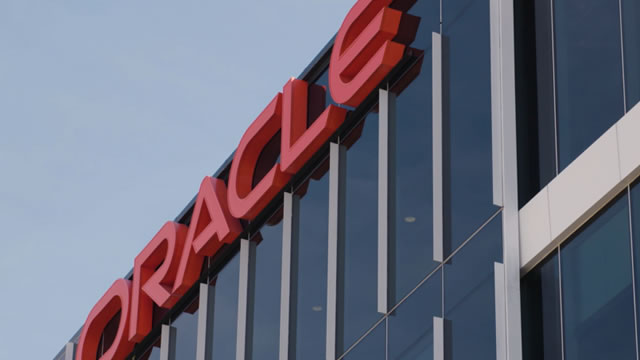
Oracle is repositioning as a value hyperscaler to power AI growth, with management guiding 34% YoY revenue growth to $90B. The bull case cites robust cloud momentum—supported by high GPU utilization and a large backlog—alongside expectations of high-20s ROIC at steady state. Despite noted execution risk, high debt, and customer concentration (notably OpenAI), the article frames the setup as a “Strong Buy,” which should be meaningfully supportive for ORCL shares (but not necessarily market-wide).
The market is likely underappreciating the reclassification effect here: if ORCL is successfully being priced as AI infrastructure rather than legacy software, the valuation debate shifts from near-term EPS to duration, asset intensity, and access to scarce GPU supply. That matters because the upside is not linear with revenue growth; a credible hyperscaler narrative can expand the multiple faster than the cash flow inflects, especially if the backlog converts cleanly over the next 2-4 quarters.
The second-order winners are not just ORCL equity holders. NVDA remains the clearest economic beneficiary if Oracle’s utilization claims are real, while power, cooling, and networking vendors with AI-exposed capex leverage can see follow-on orders. The hidden loser is the software quality bucket: if capital markets start rewarding infra-like growth from an asset-heavy incumbent, high-multiple application names may see relative de-rating as investors rotate toward “real” AI monetization.
The main risk is that concentration plus leverage turns a strong narrative into a financing story if growth slows even modestly. Backlog is only useful if conversion stays high and customer mix broadens; otherwise, one large client can dominate economics and make the equity behave like a levered private-credit proxy. The key falsifiers over 1-3 months are cloud growth deceleration, rising capex intensity, or any widening in ORCL’s credit spreads; over 6-18 months, the thesis breaks if ROIC settles well below the implied high-20s steady-state.
Contrarian view: the consensus may be too focused on revenue momentum and too little on balance-sheet absorption. If the company has to keep buying GPUs and capacity ahead of revenue recognition, reported growth can coexist with mediocre free cash flow, which caps the equity rerating. In that scenario, the bond market will tell the truth before the stock does.
AI-powered research, real-time alerts, and portfolio analytics for institutional investors.
Request TrialOverall Sentiment
strongly positive
Sentiment Score
0.45
Ticker Sentiment
