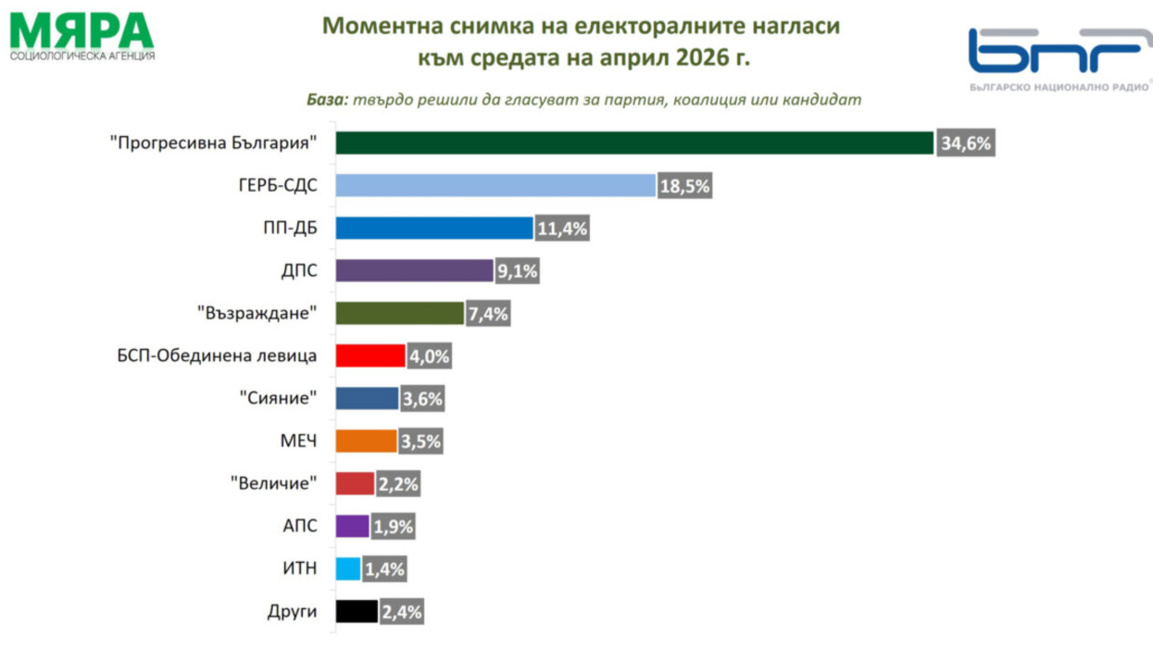
A Myara/Bulgarian National Radio survey shows Progressive Bulgaria leading with 34.6% of voting intentions, ahead of GERB-SDS at 18.5% and PP-DB at 11.4%. DPS-New Beginning is at 9.1% and Vazrazhdane at 7.4%, while BSP-United Left is near the parliamentary threshold at 4.0%. The poll, conducted April 4-13 among 1,002 adults, implies a 50.7% turnout and suggests post-election coalition or minority-government uncertainty.
This is less a “poll print” than a positioning signal for Bulgaria’s policy regime. The market implication is not the headline lead, but the unusually high probability of either a single-party cabinet or a fragmented coalition with a small number of pivotal blocs; both outcomes tend to reduce policy flexibility and raise the value of access, procurement, and regulatory optionality. In an EM context, that usually supports incumbents with domestic cash flows and near-term contract visibility while leaving banks, utilities, and infrastructure names exposed to any delay in budget formation.
The second-order risk is governance friction, not outright regime change. A coalition built around narrow majorities typically widens the “decision spread” on fiscal measures, EU-fund absorption, and anti-corruption enforcement, which can freeze capex and push project timelines out by 1-2 quarters. If turnout undershoots or vote-buying allegations intensify, the immediate market reaction is likely a local risk-premium spike rather than a sustained selloff, because the bigger driver for local assets is whether the next government can pass a budget and unlock external funding.
The contrarian takeaway is that consensus may be over-discounting volatility and under-discounting continuity. If a dominant bloc forms, the base case is not necessarily reform euphoria; it may be a more centralized, transaction-friendly environment that favors politically connected domestics and state-adjacent beneficiaries. The cleaner trade is to fade broad beta and isolate companies whose earnings depend on public spending cadence, because the setup is asymmetrically sensitive to a few weeks of coalition arithmetic.
AI-powered research, real-time alerts, and portfolio analytics for institutional investors.
Request DemoOverall Sentiment
neutral
Sentiment Score
0.00
