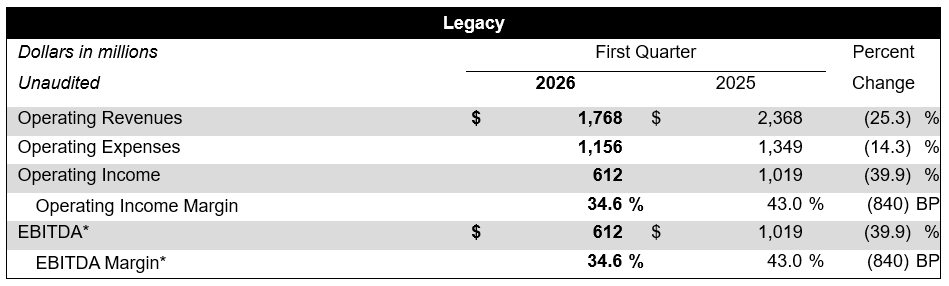
AT&T reported first-quarter revenue of $31.5 billion, up 2.9% year over year, with adjusted EPS of $0.57 versus $0.51 and adjusted EBITDA of $11.8 billion. Advanced Connectivity remained the key growth driver, with service revenue up 3.6%, 584,000 internet net adds, and the fastest-ever organic growth in its home internet convergence rate. Management reaffirmed 2026 guidance, including $18 billion+ free cash flow and about $8 billion of share repurchases, while highlighting continued fiber expansion and Lumen-related integration benefits.
The key signal is not the headline growth, but that AT&T is converting network capex into a more defensible mix shift: higher convergence means lower churn, higher ARPU, and better pricing power per household. That creates a self-reinforcing loop where fiber-heavy markets become a distribution wedge for wireless, while wireless lowers the payback period on fiber buildouts. The market should view the convergence metric as a leading indicator for margin durability over the next 4-8 quarters, not just a customer-acquisition stat.
The acquisition-related fiber expansion is strategically positive, but the near-term accounting and cash flow optics are messy. The asset sale/partner structure implies AT&T is trying to de-risk capital intensity while preserving customer ownership, which should support returns on invested capital if execution holds; however, it also means the business may look better on revenue than on reported free cash flow until the build pace normalizes. The second-order winner is likely equipment and network vendors tied to fiber deployment, while legacy copper competitors and local cable operators face a more asymmetric churn battle as AT&T’s bundled offer improves.
The biggest risk is that the convergence narrative is still dependent on continued subsidy from heavy capex and promotions. If consumer demand softens or incremental fiber penetrations slow, AT&T could be left with a higher-cost network before the cash conversion inflects. A less obvious risk is that the equity partner transaction may cap upside from the new fiber subsidiary while pushing economic value into a structure the public equity does not fully capture.
Consensus likely underestimates how much this is a multi-year margin story rather than a near-term EPS story. The setup is favorable as long as management keeps delivering convergence growth and can protect churn; if not, the market will rapidly re-rate the stock back toward a slow-growth utility multiple. In the next 1-3 quarters, the key test is whether higher fiber additions translate into sustained broadband-to-wireless attach without a step-up in promo intensity.
AI-powered research, real-time alerts, and portfolio analytics for institutional investors.
Request TrialOverall Sentiment
moderately positive
Sentiment Score
0.42
Ticker Sentiment
