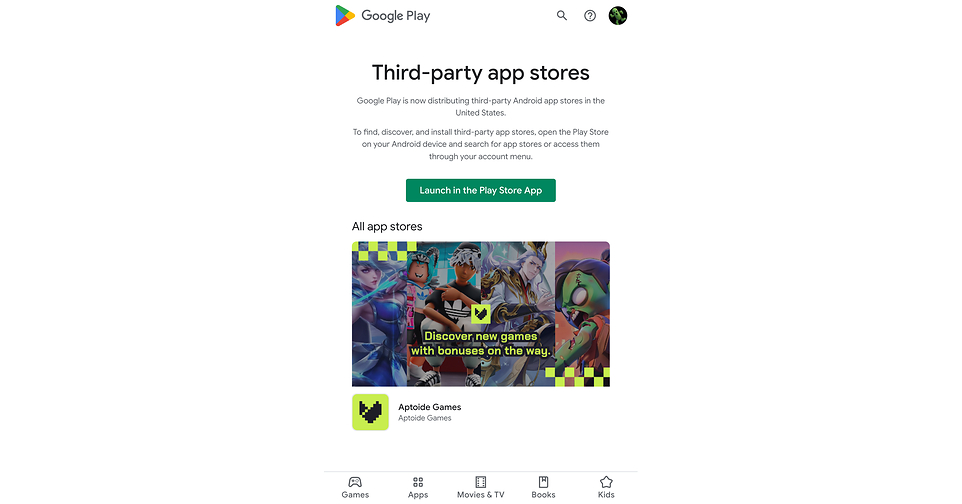
Aptoide’s Aptoide Games has been approved for distribution on Google Play in the US under Google’s Play Catalog Access program, ending a >10-year exclusion of competing Android app stores. The move enables US users to discover and install a fully featured independent games store via Google Play, targeting a reduction in distribution barriers while maintaining security measures. Aptoide cites scale of ~25M monthly active users and 400,000+ Android apps, and the launch follows ongoing regulatory pressure tied to Epic Games v. Google and broader competition scrutiny.
The immediate P&L impact is close to zero, but the regulatory signaling is not. Google is demonstrating it can permit a rival app store inside its own distribution rails on terms it controls, which weakens the narrative that Android is either closed or functionally uncompetitive. That matters more for litigation and remedy risk than for near-term revenue, because the market’s real concern is forced structural changes, not the tiny fee base tied to one niche marketplace.
Second-order, the beneficiaries are independent game publishers and alternative storefronts that can now lower user-acquisition friction; the losers are Google’s long-duration control premium and, to a lesser extent, any app-distribution business that depends on scarcity rather than product differentiation. The AAPL read-through is indirect: not a U.S. revenue hit, but another datapoint that normalizes alternative marketplaces and keeps the EU/Japan/Brazil opening narrative alive, which can compress long-run App Store multiple assumptions even if usage stays small.
Contrarian view: the market may be overpricing adoption. Security-sensitive users tend not to switch defaults, and game-only storefronts rarely move enough gross bookings to matter within 1-3 quarters. The real risk window is 6-18 months if regulators use this as precedent for broader billing/default-choice remedies; absent that, the cash-flow impact on GOOGL/AAPL should remain immaterial. Falsify the bullish regulatory read if Google expands the program materially or if court/agency actions force payment-routing changes rather than optional store listing.
AI-powered research, real-time alerts, and portfolio analytics for institutional investors.
Overall Sentiment
mildly positive
Sentiment Score
0.25
Ticker Sentiment
