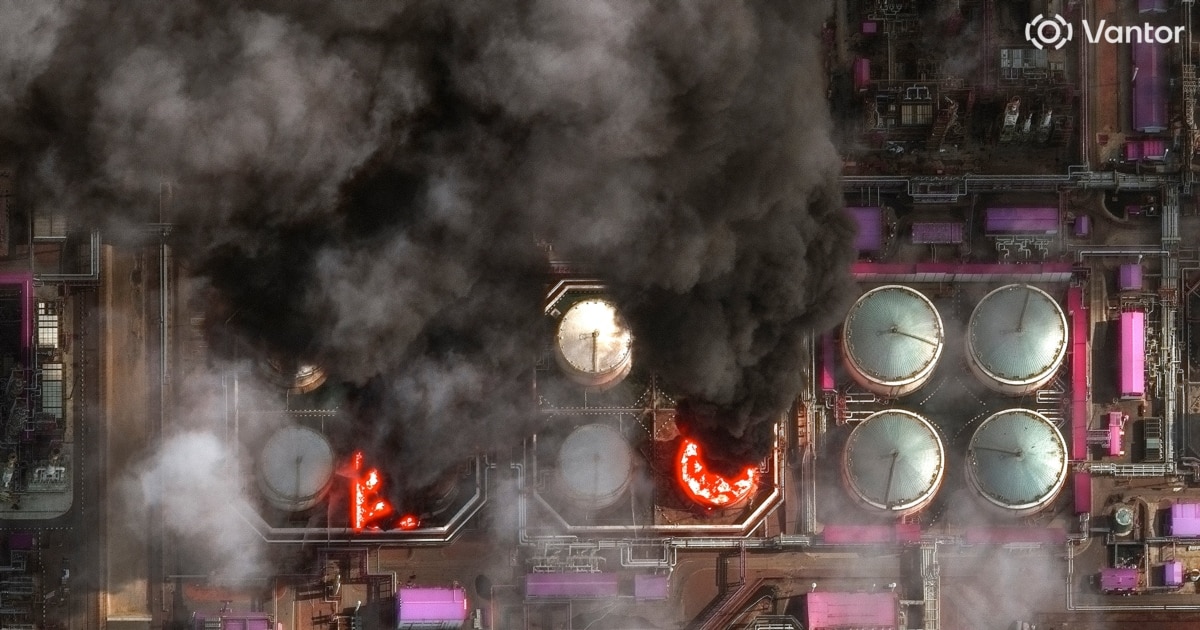
Ukraine’s drone campaign has hit Russian oil infrastructure at least 21 times in April, helping drive Russia’s crude processing to its lowest level since 2009 and forcing tighter air-defense deployment around key assets. The article says Ukrainian attacks are increasingly effective, with strikes extending hundreds to 1,200 kilometers inside Russia and creating meaningful operational and budget pressure. The broader geopolitical risk is elevated, with implications for energy supply resilience, Russian war financing, and regional security.
The market takeaway is not “Russia loses barrels,” but that the discount rate on Russian energy cash flows is rising because physical disruption is now paired with systemic air-defense saturation. That combination is harder to hedge than a one-off refinery outage: it increases the probability of rolling maintenance, deferred capex, higher domestic logistics costs, and wider export schedule uncertainty over the next 3-6 months. The second-order effect is that Russia can preserve headline production while losing realized netbacks through forced rerouting, insurance friction, and elevated inland transport costs.
The biggest beneficiary is not necessarily crude outright, but non-Russian supply chains that can replace incremental barrels and refined products in Europe, Turkey, and parts of Asia. Near term, this favors Atlantic Basin refiners, LNG/energy carriers, and integrated majors with export flexibility; it is less constructive for pure upstream producers if disruption triggers a broader demand scare or if Washington pressures allies to cap prices more aggressively. Defense and drone supply chains also gain structurally, because the campaign’s success is being measured by suppression efficiency rather than terminal damage, implying a sustained arms-race in low-cost strike systems and counter-drone layers.
Catalyst-wise, the next 30-90 days matter most: each successful deep strike raises the odds of Russian redeployment away from the Moscow ring, which would create a measurable opening for more hits on energy and military infrastructure. The main reversal risk is a step-change in Russian air defenses, better point protection around refineries, or political de-escalation tied to higher oil prices and external mediation. The contrarian miss is that the campaign may be less about collapsing Russian output than about permanently increasing volatility and capex intensity, which is enough to reprice energy risk premia even without a production cliff.
AI-powered research, real-time alerts, and portfolio analytics for institutional investors.
Request DemoOverall Sentiment
moderately negative
Sentiment Score
-0.45
