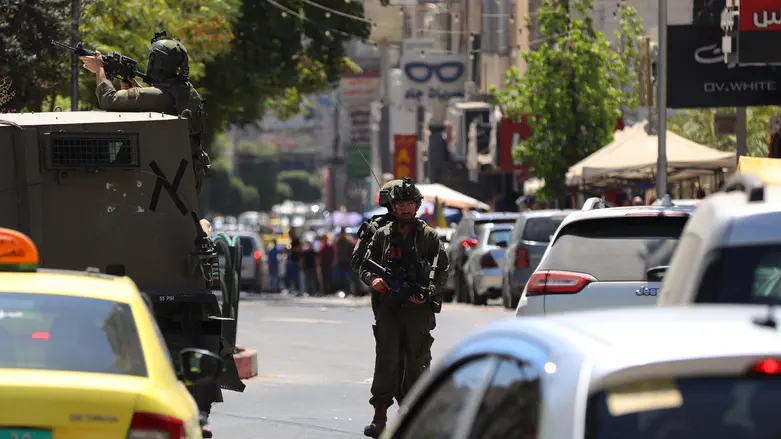
Israeli security forces mounted an hours-long search after a report that a woman in uniform entered an Arab vehicle near Elias Junction by Kiryat Arba; authorities later determined she was a Border Police soldier who had illegally entered Area A to visit a boyfriend in Yatta. Israeli and Palestinian security counterparts coordinated to extract her unharmed, she is now providing testimony, and the IDF reiterated that Israeli entry into Area A is prohibited. The episode is a localized security and regulatory breach with limited immediate market impact but highlights ongoing operational and legal risks in West Bank dynamics that could influence regional risk sentiment.
Market structure: The incident is a localized security event that marginally benefits defense/security-equipment vendors, private security contractors and surveillance-software providers while hurting Israeli local consumer-facing sectors (tourism, hospitality, local retail) by a fractional sentiment hit. Pricing power shifts are concentrated and binary — defense contractors see optionality on accelerated procurement (potential +5–15% revenue tail if multiple incidents occur), while tourism demand can suffer single-digit revenue dips regionally for 1–3 months. Across assets expect modest safe‑haven flows into USD and sovereign credit (ILS under mild pressure, 0–1% move typical), a small rise in implied vol for Israel‑focused equities and negligible immediate commodity impact.
Risk assessment: Tail risks include escalation to sustained military operations (low probability but high impact: >15% drawdown in Israeli equities), domestic regulatory tightening on soldier movements and cross-border legal frictions that could increase compliance costs for private firms. Time horizons: immediate (48–72 hours) — containment and negligible market move; short-term (weeks–3 months) — higher event-driven volatility and consumer softness; long-term (3–12 months) — potential uplift to defense capex if macropolitical pattern persists. Hidden dependencies: cross‑agency cooperation to extract the soldier implies reserve of bilateral communication reducing escalation probability; second‑order effects include tighter base-area controls harming local commerce and supply chains.
Trade implications: Direct plays — prefer concentrated, tactical longs in liquid Israeli defense exposure (Elbit Systems, ticker ESLT) sized 1–2% of NAV, with 3–9 month horizon; hedge country/ETF risk with short EIS puts. Options: buy 1–3 month EIS 5% OTM puts (size 0.5–1% portfolio) or buy ESLT 3‑month 5–10% OTM calls to lever optionality; pair trade long ESLT vs short Israeli travel/hospitality exposure via EIS overweight short. Entry: initiate in the next 1–14 days, scale if IV jumps >20% and trim at +12–18% gains or after 3–6 months.
AI-powered research, real-time alerts, and portfolio analytics for institutional investors.
Request DemoOverall Sentiment
neutral
Sentiment Score
0.00
Contrarian angles: Consensus under-reacts — markets often price these incidents as transitory while procurement cycles take months, creating an asymmetry where defense equities re-rate faster on fresh geopolitical risk; expect 10–25% outperformance for select defense names in a sustained risk period. Overdone reactions would be indiscriminate selling of Israeli equities; targeted hedges (short 1–2% EIS or buy puts) are cheaper and more effective than broad de-risking. Watch triggers: any casualty-reports, 48‑hour escalation, or official mobilization announcements — treat these as binary catalysts to increase defense longs and widen hedges.
