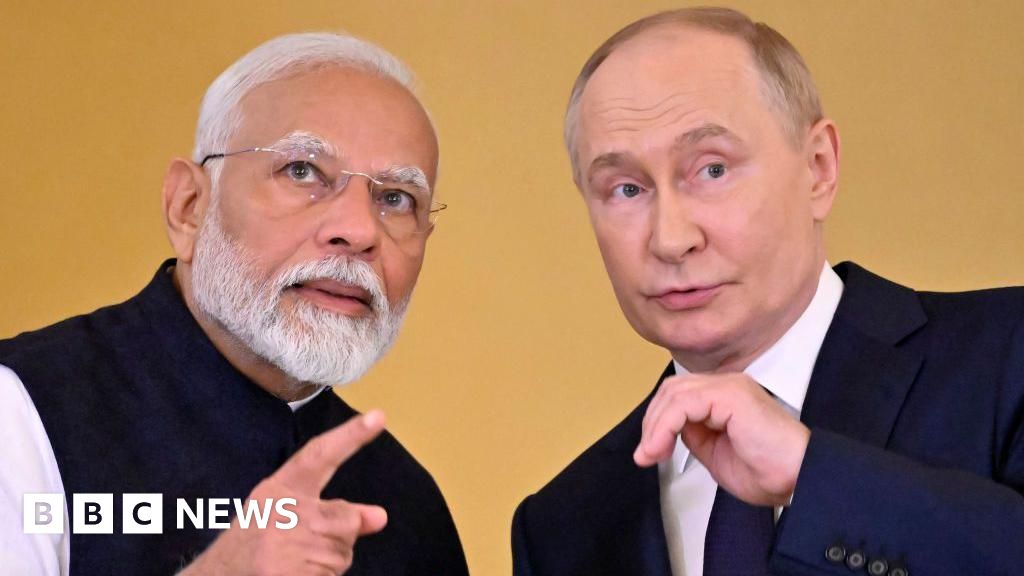
Russian President Vladimir Putin's two-day visit to India focuses on oil, defence deals and broader economic cooperation as Moscow seeks to preserve a key buyer amid Western sanctions; India's Russian crude imports rose from 2.5% pre-invasion to about 35% before falling after a US 25% tariff on Indian goods tied to Russian oil purchases. Bilateral trade surged to $68.72bn by March 2025 from $8.1bn in 2020 largely due to discounted Russian oil, creating a Russia-favouring imbalance India wants to correct by expanding non-oil trade and defence procurement (reports cite interest in S-500s and Su-57s despite Russian component shortages and S-400 delivery delays to 2026). The visit tests Modi's strategic autonomy and could influence energy supply chains, defence procurement timelines and geopolitical signaling, but is unlikely to trigger immediate market-wide moves absent firm contract announcements.
Market structure: Putin’s Delhi trip signals attempts to restore discounted Russian crude flows to India and secure defence exports. Direct winners: Indian refiners (high-run margins on cheap Urals), tanker owners (long-haul Asia flows) and Indian defence OEMs if Russia delays deliveries; losers: EU refiners previously advantaged by disrupted Russian barrels and Western defence primes if India doubles down on Russian kit. If Indian oil intake returns toward the 30%+ share seen in 2023, global oil balances could see an incremental ~0.5–1.0 mb/d redirected to Asia, capping Brent upside by an estimated $5–10/bbl versus a no-diversion baseline.
Risk assessment: Tail risks include US escalation of secondary sanctions or higher tariffs on Indian goods (already 25% in October) that could force an abrupt Indian pivot within weeks–months, and Russian production/logistics shocks that suddenly remove barrels from market. Immediate catalysts: summit communiqués (days), US-India tariff talks (weeks), and delivery schedules for S-400/S-500 or Su-57 (into 2026). Hidden dependencies: Russian component shortages (semiconductors, avionics) that create multi-year slippage and create a window for Indian domestic suppliers.
Trade implications: Tactical plays: long Indian refiners and select tanker equities for a 3–12 month horizon; add domestic defence exposure on 6–24 month procurement cycles. Use options to express asymmetric views — buy Brent downside protection via a 3-month put spread if you fear a Russian barrel flood, or long tanker call options to lever a short-term freight spike ahead of contract renewals. Rebalance away from Europe-centric refining exposure if summit restores Asia flows.
Contrarian angles: Consensus assumes India will capitulate to US pressure; history (India’s 2022–24 buying) shows strong preference for strategic autonomy when discounts exceed ~$15–$20/bbl. Mispricing likely in tanker names and smaller Indian defence stocks where multi-year contracts and diverted cargoes are under-appreciated; unintended consequence: closer India-Russia ties could worsen India-US economic ties, creating regime-risk premia in Indian exporters that the market may not yet price.
AI-powered research, real-time alerts, and portfolio analytics for institutional investors.
Request DemoOverall Sentiment
mixed
Sentiment Score
-0.05
