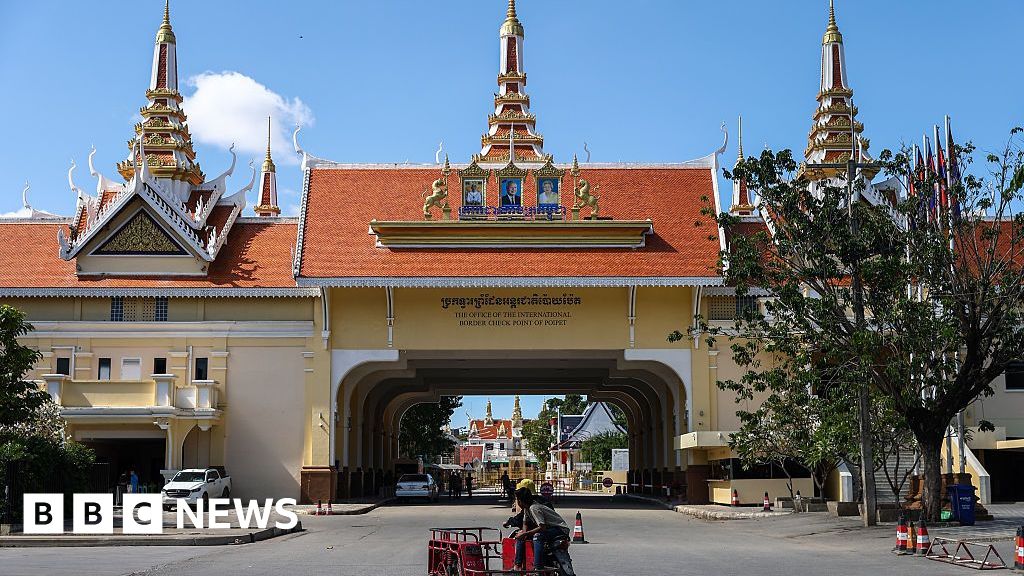
Thai forces bombed a facility near Poipet, a major casino hub and the largest land crossing with Cambodia, saying they targeted a storage site for BM-21 rockets; Cambodia reports two bombs were dropped. Renewed border clashes have killed at least 21 people in Thailand and 17 in Cambodia, displaced roughly 800,000 civilians, prompted closure of land crossings that left 5,000–6,000 Thai nationals stranded and raised acute near-term risks to cross-border trade and tourism (including threats to Siem Reap/Angkor), increasing geopolitical tail risks for regional assets.
Market structure: Immediate winners are defense contractors and regional private security/logistics firms that can capture expedited government spending and emergency freight (expect +5-10% revenue tailwind for contractors if procurement accelerates over 3-12 months). Clear losers are travel, casino and border-dependent logistics (Poipet/Aranyaprathet corridor) where daily cross-border traffic disruption can cut local revenues 50-90% and push short-term pricing power to alternative routes and air travel. Cross-asset: expect EM-Asia sovereign spreads to widen 30–100bp, THB to weaken 2–5% vs USD, USTs to rally (yields -10–30bp) and gold to appreciate as a safe haven.
Risk assessment: Tail risks include escalation into broader Thai-Cambodian front or Chinese/ASEAN diplomatic spillover that could force prolonged border closures (>3 months) and materially hurt Thai tourism/GDP (downside scenarios ~0.3–1.0% GDP impact). Near-term (days) volatility will be headline-driven; short-term (weeks–months) risks are earnings misses in tourism and logistics; long-term (quarters) risks include supply-chain re-routing and asset relocation (casinos). Hidden dependencies: exposure to Chinese tourist flows, ASEAN trade corridors, and U.S. diplomatic leverage that can rapidly change outcomes. Key catalysts: credible ceasefire for 30+ days (risk-off reversal) or loss of control of key border towns (risk-on to risk-off).
Trade implications: Direct plays — establish modest long exposure to defense names (Lockheed LMT, Raytheon RTX) sized 2–3% NAV combined for 3–12 months; reduce Thailand travel/tourism exposure by trimming AOT.BK and MINT.BK positions 30–50% or cut 3–5% weight in THD ETF immediately. FX/bonds — take a 0.5–1% NAV USD/THB long (or buy 1-month calls) targeting a 2–4% move, and increase UST 2–10y allocation by 3–5% to hedge a risk-off leg down. Options — buy 3-month AAXJ puts (~7.5% OTM) sized to protect 2–3% of Asia/EM exposure.
Contrarian angles: Consensus may oversell Thailand equities — history (2014 unrest) shows localized political/security shocks often mean-revert within 6–9 months; selectively buy high-quality, domestic-revenue Thai names (staples, telecoms) on a 15–25% pullback. The market may underprice rapid tourism rebound post-ceasefire; therefore limit shorts to 3 months and light size (max 3% NAV). Monitor objective triggers (30-day ceasefire, flight-data, THB moves >3%, sovereign CDS +50bp) to flip positions.
AI-powered research, real-time alerts, and portfolio analytics for institutional investors.
Request DemoOverall Sentiment
strongly negative
Sentiment Score
-0.60
