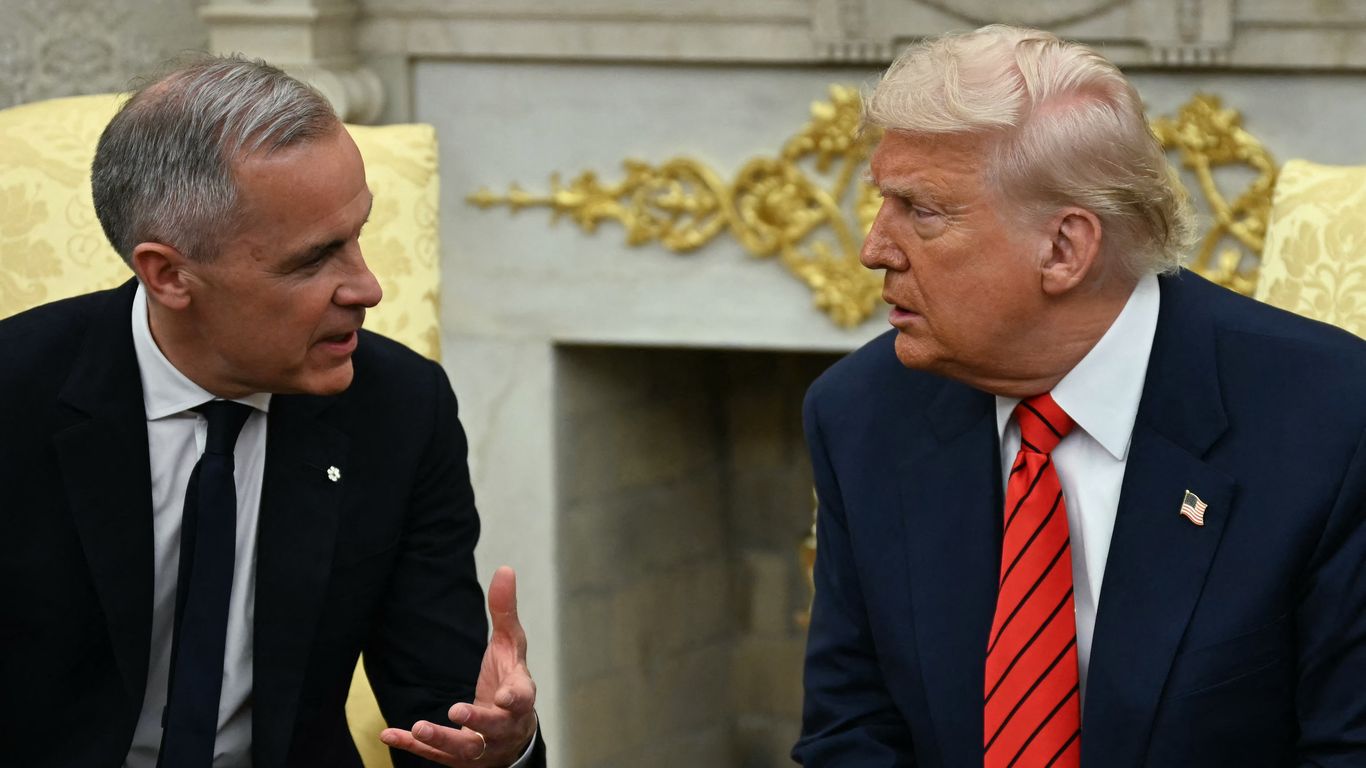
President Trump has threatened to derail a trade deal with Canada, potentially imposing a 35% tariff on Canadian goods, following Prime Minister Mark Carney's announcement of intent to recognize Palestinian statehood. This development, occurring just one day before Trump's August 1 trade deadline, highlights how geopolitical stances are directly impacting bilateral trade relations and aligns Canada with other key U.S. allies, further isolating the U.S. and Israel internationally.
A significant geopolitical risk has been abruptly introduced into the U.S.-Canada trade relationship, with President Trump directly linking a potential trade deal to Canada's diplomatic stance on Palestinian statehood. The threat to impose a 35% tariff on Canadian goods, issued just one day before the August 1 deadline, creates acute uncertainty for one of the world's largest trading partnerships. This development, labeled as having a 'strongly negative' sentiment and 'high' market impact, suggests a material risk to integrated North American supply chains. Canada's foreign policy decision aligns it with other key U.S. allies like France and the U.K., highlighting a potential diplomatic isolation of the Trump administration. The situation underscores a volatile environment where non-economic factors are dictating trade policy, posing a direct threat to industries reliant on stable cross-border commerce.
AI-powered research, real-time alerts, and portfolio analytics for institutional investors.
Request DemoOverall Sentiment
strongly negative
Sentiment Score
-0.70
