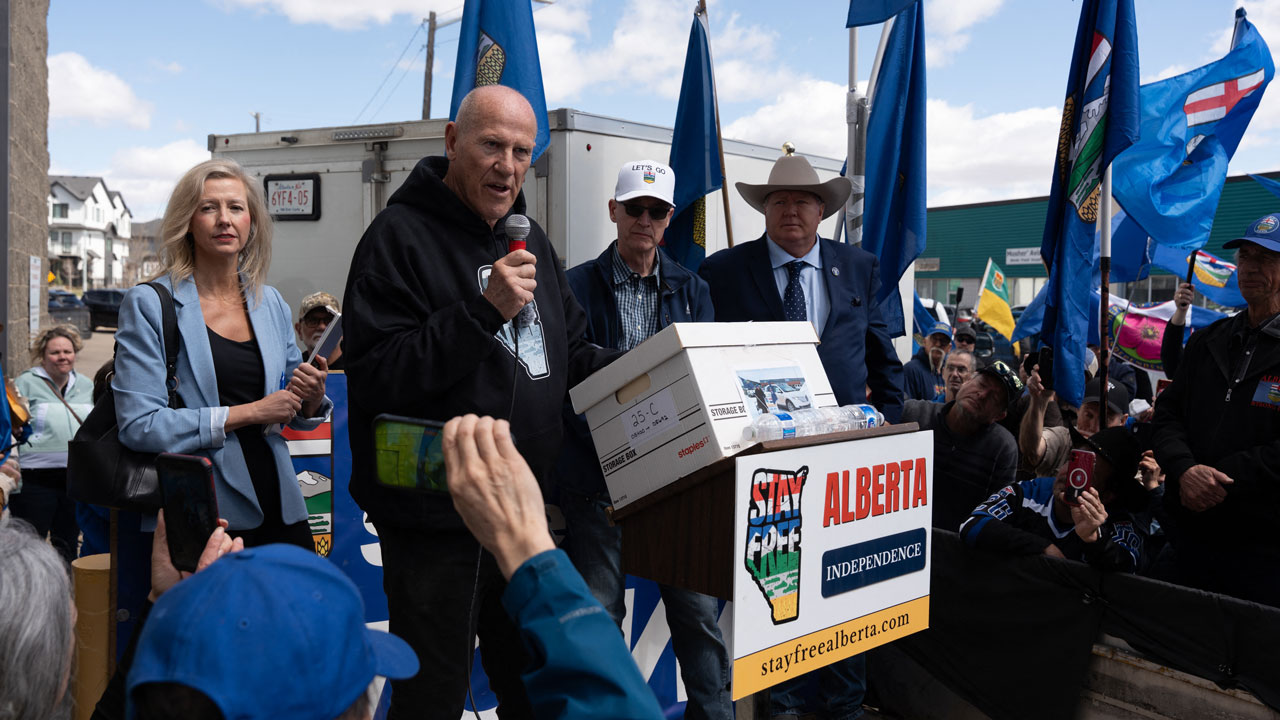
Alberta separatists say they have gathered 302,000 signatures, well above the 178,000 required, to force a referendum on whether Alberta should leave Canada. Premier Danielle Smith has said a vote could be held as early as October if signatures are verified, but the initiative faces legal challenges from Indigenous groups and a likely uphill battle given polling below 30% support for independence. The article is primarily political and legal in nature, with limited direct market impact beyond potential energy-policy uncertainty.
This is less a binary separatist event than a sustained policy volatility regime for Canadian risk assets. The first-order market impact is not on Alberta itself but on assets exposed to federal-provincial fiscal transfers, permitting, and energy infrastructure optionality: the risk premium on Canadian pipelines, midstream, and upstream capex should widen if the ballot clears, even if the referendum ultimately fails. The key second-order effect is that companies with long-dated Canadian projects may start discounting a higher probability of regulatory fragmentation and delayed FIDs, which can suppress multiples before any legal outcome is known.
The bigger medium-term catalyst is Ottawa’s response function. If the federal government leans hard against the process, it may unintentionally strengthen the separatist coalition and extend the timeline of uncertainty into 2026, which is more damaging for investment than the referendum itself. Conversely, if the political establishment offers Alberta concessions on royalties, pipelines, or emissions enforcement, the trade shifts from constitutional risk to fiscal accommodation, which would be bullish for Western Canadian energy differentials and local credit spreads.
The consensus may be underpricing the legal/Indigenous wrinkle. Even a weak court challenge can delay verification, ballot wording, or post-vote negotiations, creating a months-long headline overhang without requiring a decisive public mandate. That favors option structures over outright directionals: the event is likely to generate volatility, but the base rate still looks like a failed independence bid with a prolonged bargaining phase rather than an imminent breakup.
AI-powered research, real-time alerts, and portfolio analytics for institutional investors.
Request DemoOverall Sentiment
neutral
Sentiment Score
-0.05
