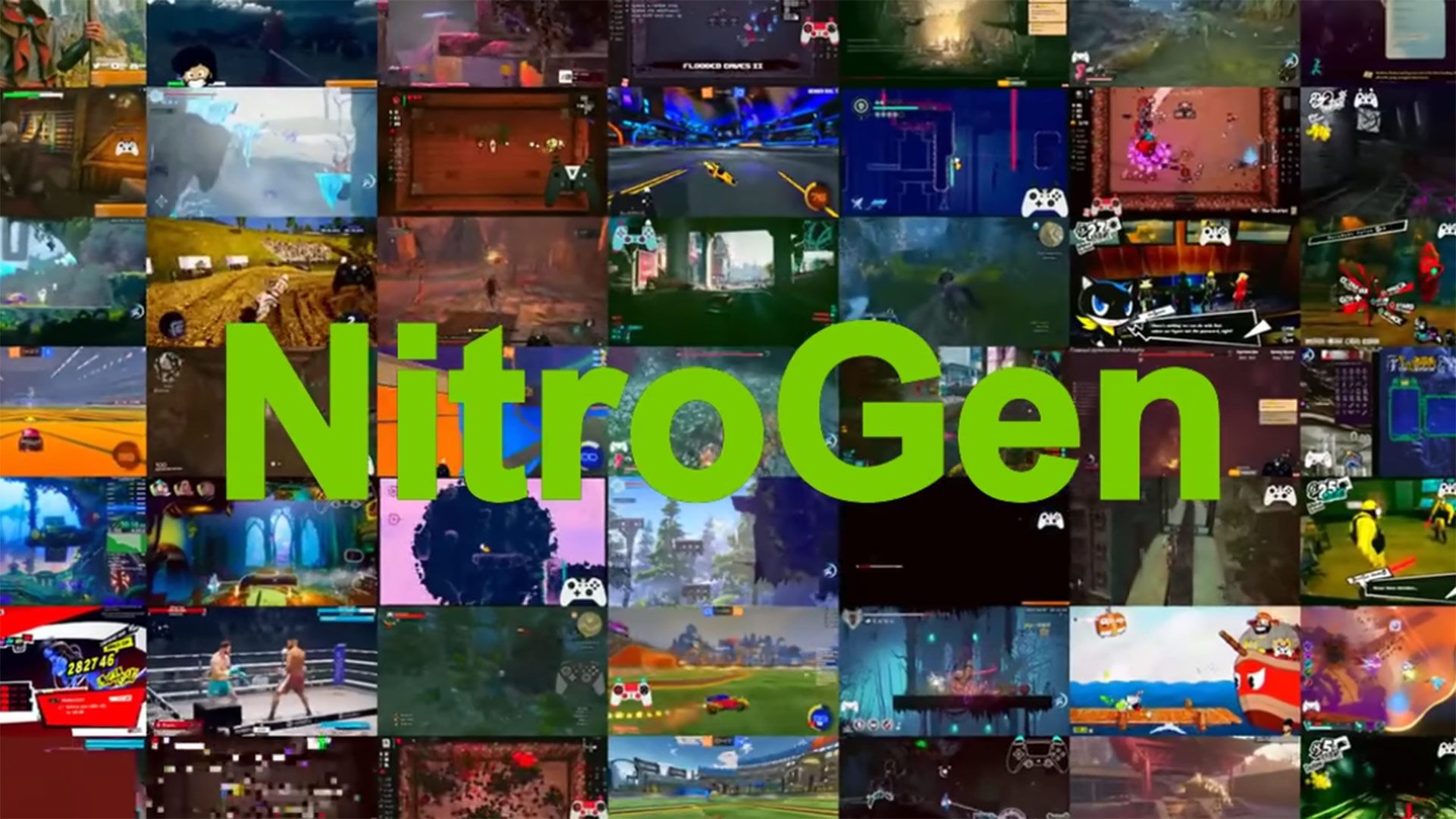
Nvidia-led researchers (with collaborators from Stanford, Caltech and others) released NitroGen, an open-source, generalist gaming AI built on the GROOT N1.5 architecture and trained on 40,000+ hours of streamer gameplay spanning 1,000+ titles. The model focuses on fast motor control and achieved a reported 52% relative improvement in task success versus models trained from scratch, performing across diverse genres and procedurally generated worlds; the team highlights broader implications for simulation and robotics, though the effort is described as an early-stage research milestone rather than an immediate commercial product.
Market structure: NitroGen materially deepens the software moat around high-performance GPUs and cloud inference — direct winners are NVDA (accelerator sales + datacenter ASP leverage) and cloud providers (AMZN, MSFT, GOOGL) that sell GPU time. Expect a sustained 2–5% incremental demand for datacenter GPU cycles over 12 months from research, SDKs, and developer adoption, supporting pricing power vs. legacy GPU cycles. Gaming publishers may see mixed impact: accessibility features expand user base but create anti-cheat/legal friction that can depress competitive esports monetization.
Risk assessment: Key tail risks are regulatory export controls on high-bandwidth memory/AI accelerators, IP suits from streamers over training data, and rapid commoditization if open-source forks remove vendor lock-in — any one could compress multiples by >20% within 6–12 months. Immediate (days) impacts are sentiment-driven; short-term (weeks–months) are bookings and OEM supply signals; long-term (quarters–years) depends on monetization of tooling for robotics/enterprise. Hidden dependencies include cloud GPU supply, electricity/cooling constraints for hyperscalers, and anti-cheat technical adoption.
Trade implications: Direct play is NVDA long with cloud-infra complements (AMZN/MSFT); relative value: NVDA/AMD pair (long NVDA, short AMD) to capture software+ecosystem premium. Options: use defined-risk call spreads on NVDA (6–9 months) to express upside while capping premium. Rotate into semiconductors, cloud infra, and enterprise AI tooling; trim pure-play peripheral/controller stocks that face feature obsolescence.
Contrarian angles: Consensus understates friction from anti-cheat, legal and latency constraints — mainstream gaming adoption could take 12–24 months, not immediate. Conversely, open-source release could accelerate robotic and simulation adoption outside gaming, creating a multi-year TAM expansion even if gaming monetization lags. Watch for compute overbuild risk: a GPU capacity glut in 12–18 months could flip winners into re-rate losers.
AI-powered research, real-time alerts, and portfolio analytics for institutional investors.
Request DemoOverall Sentiment
mildly positive
Sentiment Score
0.35
Ticker Sentiment
