


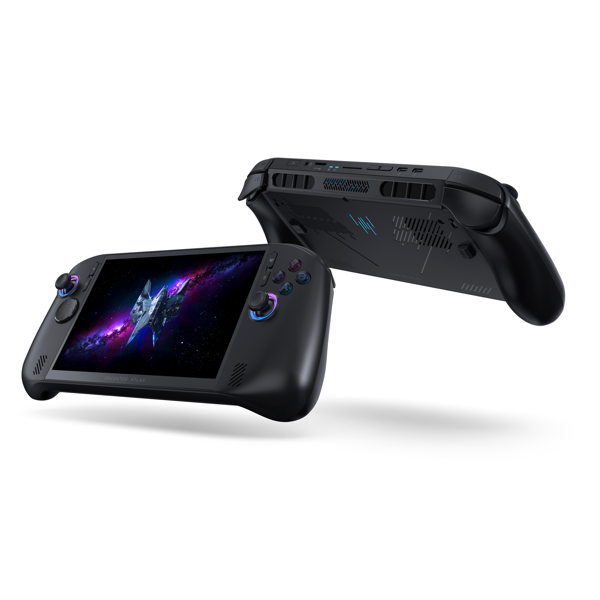
Acer launched the Predator Atlas 8 gaming handheld, powered by up to Intel Arc G3 Extreme processors and up to Intel Arc B390 graphics, with an 8-inch WUXGA 120 Hz VRR display and up to an 80 Wh battery. The device emphasizes handheld performance features including Intel XeSS 3 AI upscaling, dual-fan Predator AeroBlade cooling, Windows 11/XBOX Game Pass integration, and wireless connectivity via Intel Killer Wi-Fi 7. Availability is slated for North America, EMEA, and Australia starting October 2026.
This is more meaningful for Intel than for Acer: the handheld category is still small, but it is one of the few consumer endpoints where AI-adjacent silicon, graphics, and power efficiency can be marketed as a single performance story. If this platform gains traction, it improves Intel’s odds of expanding into a niche where differentiation matters more than raw notebook share, and where OEM design wins can create a longer tail of follow-on SKUs and accessory attach. The first-order revenue is modest; the second-order value is in validating a mobile gaming reference design that can be reused across other partners and geographies.
The supply-chain readthrough is actually cleaner for Corning than for the CPU/GPU ecosystem: premium handhelds need durability, glare reduction, and scratch resistance to justify higher ASPs, and that tends to support component mix rather than unit volume. Microsoft also gets an incremental ecosystem push because Windows handheld UX remains a gating factor; any successful device that lowers friction between game launchers, peripherals, and system tools reinforces Windows as the default PC-gaming OS, which is strategically useful even if the handheld itself is not a big seller.
The contrarian point: the market may overestimate near-term commercial impact because handheld gaming is still a taste-driven category with brutal product-cycle risk. Battery life, thermals, and software friction tend to matter more in week 6 than launch week, so the key catalyst window is the first 1-2 quarters after release, not the announcement itself. If reviews flag noise, thermal throttling, or weak real-world battery under 120 Hz use, the entire thesis compresses quickly; conversely, strong community adoption could unlock a multi-year niche, but that’s a higher bar than a press release suggests.
AI-powered research, real-time alerts, and portfolio analytics for institutional investors.
Request TrialOverall Sentiment
moderately positive
Sentiment Score
0.45
Ticker Sentiment
