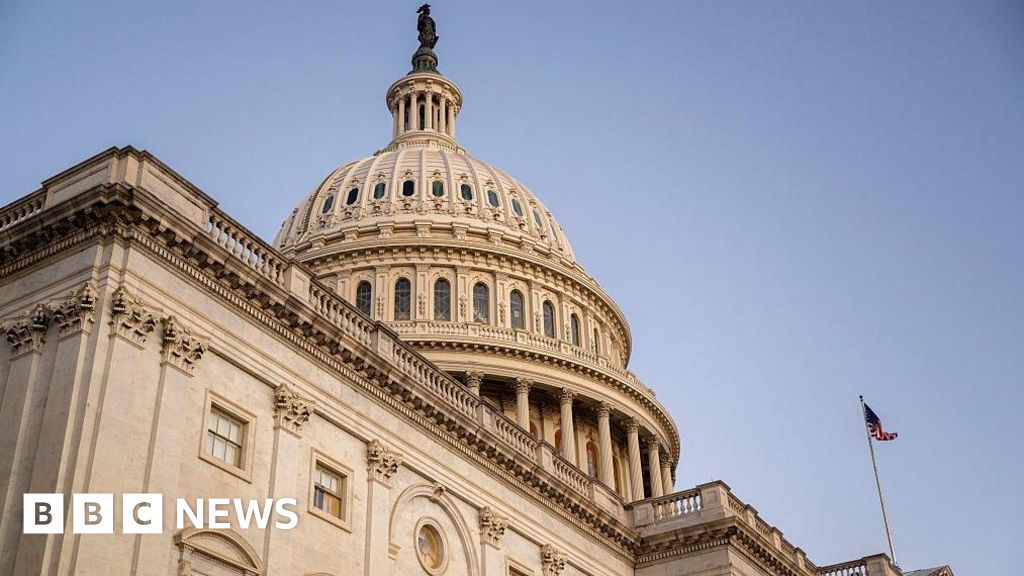
The US Senate is scheduled to vote on a resolution sponsored by Sen. Tim Kaine that would curtail President Trump’s authority to order further military action against Iran and require withdrawal of US forces unless Congress approves the operation; a majority of Senate Democrats are expected to support it while most Republicans plan to block it. The measure needs a simple Senate majority to pass but would then face a House vote, an anticipated presidential veto and require two-thirds in both chambers to override; the vote follows five days of strikes between the US/Israel and Iran that have produced US casualties and regional escalation. The article notes administration claims it complied with the War Powers Resolution’s 48-hour notification rule and places the dispute in the broader context of the 1973 War Powers Act and post‑9/11 AUMF reliance.
Market structure: Near-term winners are defense primes (LMT, NOC, RTX), oil & integrated producers (XOM, CVX), and safe-haven vehicles (GLD, TLT) from higher risk premia and potential supply disruptions; losers include airlines (DAL, UAL, AAL), tourism-related consumer names, EM equities and regional banks with MENA exposure. Pricing power will transiently shift to energy suppliers and insurers (war-risk premiums for tankers), while defense contractors gain order-visibility and higher margins if Congress authorizes funding within 3–12 months.
Risk assessment: Tail risks include full-scale US-Iran confrontation, blockade of the Strait of Hormuz, or major cyberattacks on energy/infrastructure — low probability (<15% next 6 months) but high impact (oil +30%+, equities -15%+). Immediate (days) effects: volatility spikes, oil/gold jumps; short-term (weeks–months): risk premia and freight/insurance costs reprice; long-term (1–3 years): defense budgeting and AUMF/legislative changes alter contractor revenue visibility. Key hidden dependency: shipping insurance cost dynamics can amplify oil price moves without physical supply loss. Catalysts: Senate/House votes, US/Israel military escalation, large-scale strikes on shipping or energy infrastructure.
Trade implications: Tactical long bias to defense and energy, hedge with GLD/TLT and VIX protection; short travel/leisure and select EM exporters if oil spikes. Use options to buy downside protection (VIX or SPX puts) and cost-efficient call spreads on XOM/CVX for directional exposure. Entry: scale into positions within 48–72 hours of sustained oil move >+5% or VIX >20; re-evaluate at 6–8 weeks or if oil breaches $110/bbl.
Contrarian angles: Consensus may overprice permanent defense upside — a successful War Powers resolution or Congressional funding fights can compress defense multiples and create a 10–20% mean-reversion risk for primes. Geopolitical oil spikes have historically faded in 2–3 months absent supply outages (2019 precedent); short-term momentum trades in oil/energy may be overdone. Unintended consequence: a stronger USD from safe-haven flows could pressure commodity exporters, amplifying stress in EM credit and creating relative-value shorts in EEM vs. XLE.
AI-powered research, real-time alerts, and portfolio analytics for institutional investors.
Request TrialOverall Sentiment
moderately negative
Sentiment Score
-0.35
