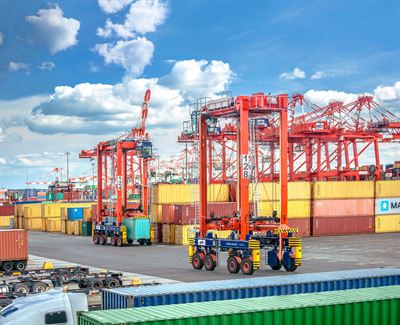
Port Newark Container Terminal has placed a repeat order for 20 Konecranes Noell hybrid straddle carriers (booked Q4 2025, delivery Q4 2026), following a prior purchase of 15 hybrids in Q4 2024. The machines combine a diesel genset with rechargeable batteries for lower fuel consumption and emissions and will be used for quayside, stacking and truck/rail operations; the repeat order underscores PNCT's long-term reliance on Konecranes equipment and supports Konecranes’ Ecolifting decarbonization roadmap. For context, Konecranes reported Group sales of EUR 4.2 billion in 2024; while strategically positive for recurring equipment and service revenue and ESG positioning, the order is unlikely to be material to market pricing of the stock.
Market structure: The PNCT repeat order (20 hybrid straddle carriers booked Q4 2025, delivered Q4 2026) reinforces Konecranes (Nasdaq Helsinki: KCR) as a dominant supplier for US East Coast terminals and signals a steady port-level capex cycle; 20 units against a historical >200-order base is ~10% incremental for PNCT and a material service-revenue runway for KCR over 3–5 years. Hybrids raise KCR’s pricing power in the retrofit/aftermarket segment (spare parts/service margins), while marginally reducing diesel suppliers’ short-term volumes (diesel demand impact <0.1% of global refined product demand). Competitive dynamics favor incumbents with local service footprints; new entrants face higher distribution and support costs.
Risk assessment: Tail risks include rapid technological leapfrogging to full electrification/hydrogen (stranding hybrid hardware), battery supply-chain shocks (price or availability), and concentration risk from large repeat customers (single-terminal exposure). Immediate market impact is negligible (days); expect visible earnings uplift for KCR in short-term order-book disclosures (quarters) and meaningful margin expansion in 12–36 months if after-sales adoption scales. Hidden dependencies: aftermarket spare-part margins and proximity of service centers drive total lifetime ROI far more than initial unit sale price.
Trade implications: Primary actionable is a selective long in KCR (size 2–3% portfolio) aiming for +20–30% upside in 12 months driven by repeat orders and aftermarket lift; hedge with a 12-month call spread to cap downside. Pair trade: long KCR (2%) / short Caterpillar (CAT) (1%) over 12–36 months to capture margin rotation toward electrified port equipment. Rotate +1–2% into automation/electrification names (ABB) and reduce 1–2% exposure to refiners (VLO/PSX) where diesel demand is structurally pressured.
Contrarian angles: Consensus underweights recurring aftermarket revenue — conservative models likely miss 100–200 bps margin upside if hybrids scale across major US ports. The market may be underreacting; the risk of overreaction is that rapid full electrification (or large federal grants favoring catenary/shore-power instead of hybrids) could shorten hybrid demand horizon. Historical parallel: industrial equipment OEMs that controlled service networks (e.g., rail signaling) captured disproportionate profits; same pattern could play out here.
AI-powered research, real-time alerts, and portfolio analytics for institutional investors.
Request DemoOverall Sentiment
moderately positive
Sentiment Score
0.45
