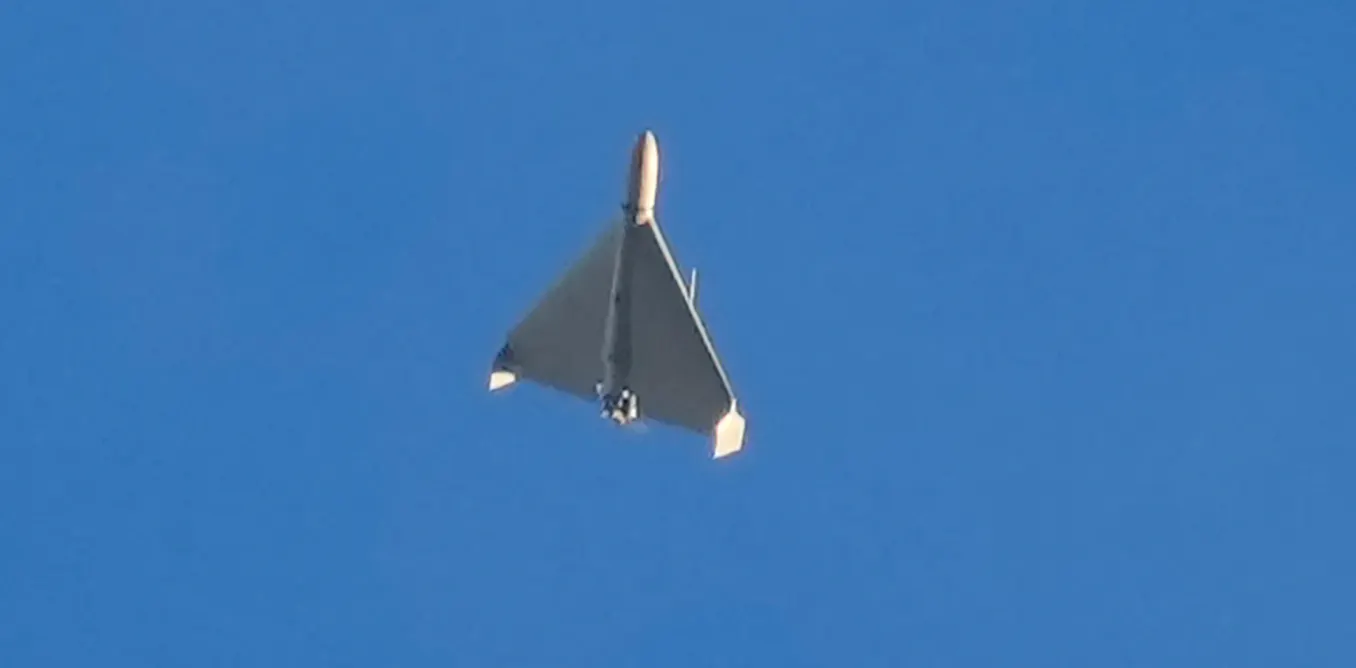
The article argues that low-cost one-way attack drones are reshaping modern warfare, with Iran, Russia and Ukraine demonstrating the ability to overwhelm defenses through 'precise mass.' It cites Shahed-136 drones with ranges up to 1,250 miles and costs of $20,000-$50,000 each versus $2 million for a Tomahawk missile, while noting FPV drones can be built for a few hundred dollars and used effectively at about 12 miles when fiber-optic linked. The piece highlights substantial escalation risk for U.S. and allied forces and implies growing demand for counter-drone and air-defense capabilities.
The market implication is not “more drones” in the abstract; it is a re-rating of the cheapest layer of the defense stack and a margin-pressure event for every platform that assumes expensive interceptors are the answer. If low-cost one-way systems keep scaling, the asymmetry shifts toward seekers, EW, command-and-control, passive sensing, and attritable counter-drone munitions rather than exquisite air defense missiles. That favors vendors with software-defined integration and high-volume consumables, while pressuring contractors whose value proposition is tied to a finite inventory of premium interceptors.
The second-order effect most investors miss is procurement acceleration: once commanders see aircraft, logistics nodes, and radar sites repeatedly taken out by sub-$50k systems, budget authority migrates from platform spending to layered base defense and dispersion. That should support small/mid-cap names in counter-UAS, RF jamming, fiber-optic sensing, thermal optics, and autonomous tracking, but the winners may be more fragmented than the primes. Meanwhile, Amazon is a weak read-through only in the sense that the article highlights how thoroughly commercial supply chains, off-the-shelf components, and online retail enable weaponization; it is not a direct earnings issue, but it is a reminder that civilian distribution and marketplace governance could face scrutiny if dual-use restrictions tighten.
The contrarian risk is that consensus overestimates how quickly this becomes a pure defense-budget tailwind. Some of the spend is substitutionary: dollars move from legacy missiles and manned platforms into cheap drones and defenses, so the net addressable uplift is smaller than headline urgency implies. The real catalyst is a fresh battlefield shock—e.g., a successful strike on a base, ship, or aircraft—to force doctrine change; absent that, the trade can stall over months as inventory, export controls, and production bottlenecks normalize expectations.
AI-powered research, real-time alerts, and portfolio analytics for institutional investors.
Request DemoOverall Sentiment
moderately negative
Sentiment Score
-0.35
Ticker Sentiment
