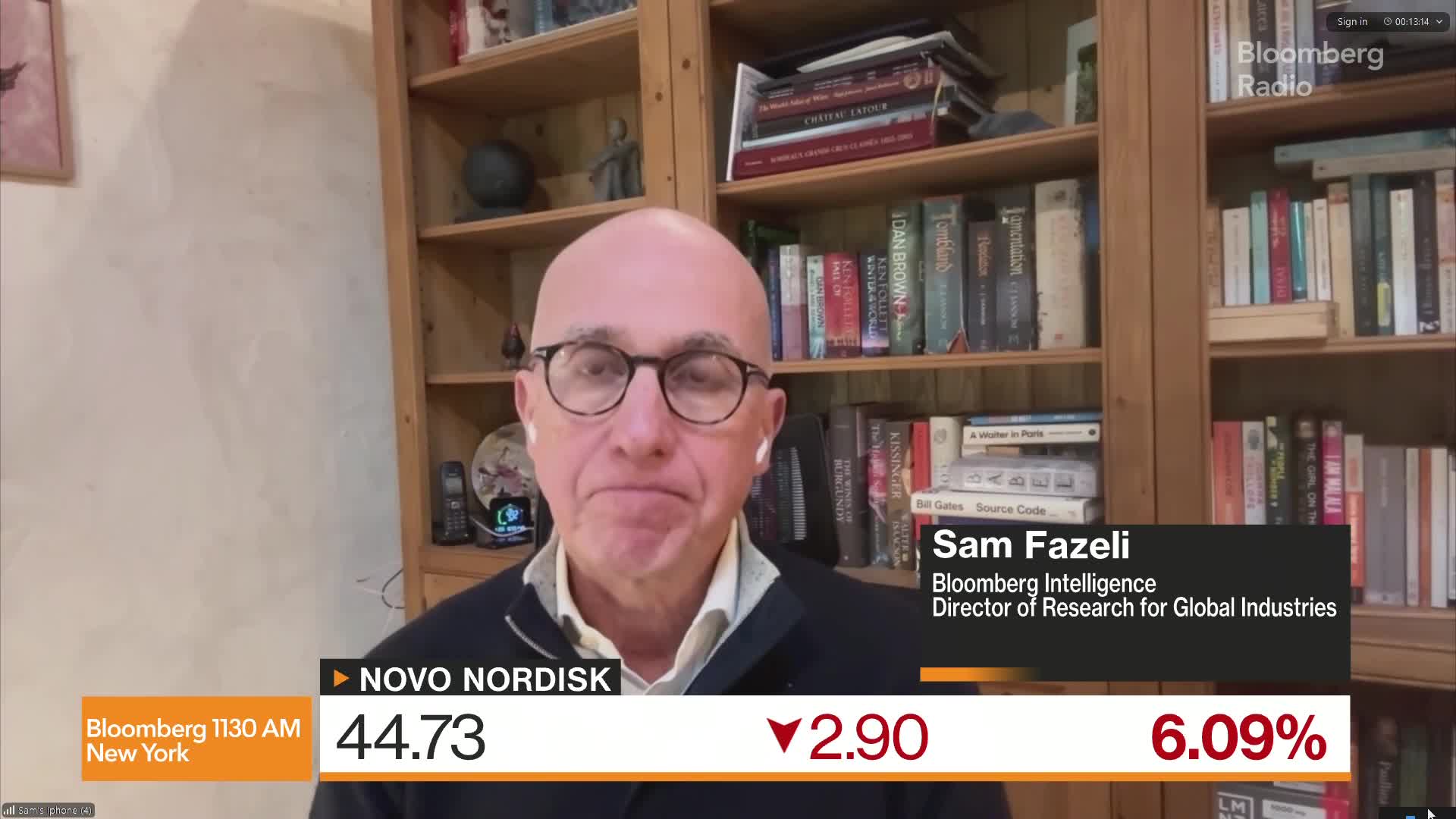
Novo Nordisk reported that a pill version of Ozempic failed to slow Alzheimer’s disease progression in two high‑risk studies, missing the cognitive assessment endpoint; the company will discontinue a planned one‑year extension of the trials. Shares plunged as much as 12.4% in Copenhagen to their lowest level since July 2021, removing a potential new indication for its GLP‑1 franchise and materially weighing on the stock’s near‑term outlook and investor sentiment.
Market structure: The failed Alzheimer’s indication removes a high-value optionality and shifts investor focus back to base GLP-1 diabetes/obesity economics; expect downward pressure on multiples for GLP-1-exposed names for 3–6 months as sell‑side reweights TAM assumptions by ~10–25%. Direct beneficiaries in the short run are large diversified pharma with stable pipelines (e.g., LLY, PFE) and cash-rich acquirers that can buy discounted assets; small-cap Alzheimer/tau players lose relative bid. Cross-asset flows should be risk-off: equity vols up (NVO IV +), credit spreads on cyclical pharma could widen 10–30bp, and safe‑haven flows may modestly depress EUR basis vs USD for days.
Risk assessment: Immediate tail risks are cascading trial failures or a guidance cut within 30–90 days that forces a larger re‑rating; medium tail is payer-driven GLP‑1 price pressure if multiple indications fail, compressing margins over 1–3 years. Hidden dependencies include dealer hedges and concentrated passive weights in NVO that can amplify moves mechanically; options gamma could force further volatility next 1–6 weeks. Key catalysts: quarterly guidance, analyst revisions over 4–8 weeks, and any competitive label expansion from LLY or market access rulings.
Trade implications: Short-term, favor defined-risk bearish exposure on NVO via 3-month put spreads sized to 1–2% portfolio notional to capture >15% downside while limiting premium. Implement a pair trade: long 2% LLY equity vs short 2% NVO equity for 6–12 months to express rotation to diversified pharma; exit if relative performance diverges >10% or after 12 months. Reduce high‑beta biotech exposure by 3–5% and reallocate to large-cap pharma (LLY/PFE) within 4 weeks.
Contrarian angles: The market likely overprices permanent damage to core semaglutide revenue — absent payer actions the diabetes/weight franchise still drives multi‑year cash flows; a >20% additional drop would create a favorable asymmetric buy zone for a 3+ year hold. Historical parallels (failed secondary indications) show 6–12 month mean reversion once base product growth remains intact; unintended consequence — accelerated M&A interest in NVO assets if valuation dislocation >15–25%.
AI-powered research, real-time alerts, and portfolio analytics for institutional investors.
Request DemoOverall Sentiment
strongly negative
Sentiment Score
-0.70
Ticker Sentiment
