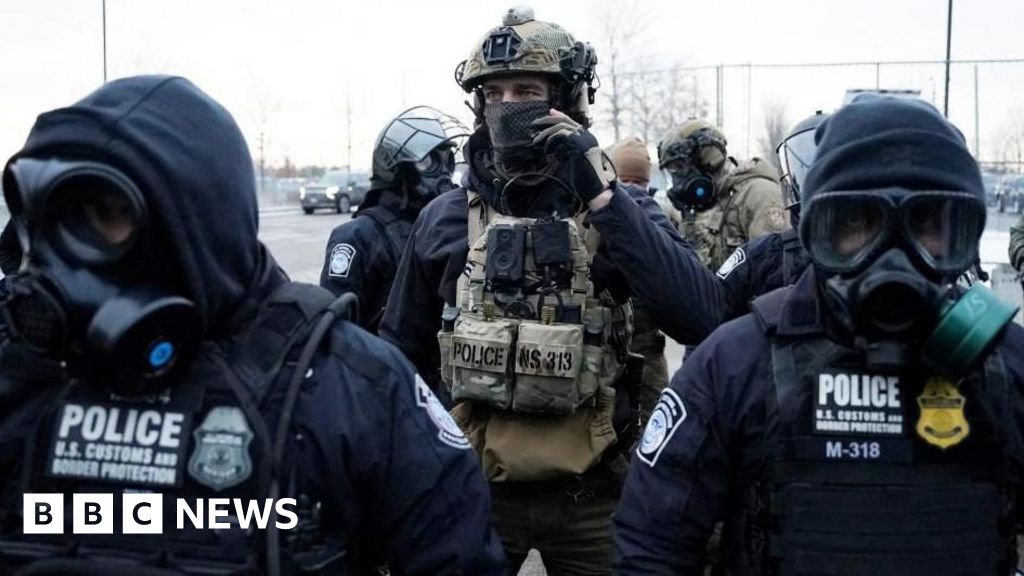
Approximately 1,500 soldiers from the 11th Airborne Division in Fort Wainwright, Alaska, are on standby for possible deployment to Minneapolis as authorities respond to ongoing anti-ICE demonstrations sparked by the fatal shooting of Renee Good on January 7. No deployment decision has been made; Governor Tim Walz has mobilized the National Guard while a federal judge has limited federal agents' crowd-control tactics and the Trump administration has threatened to invoke the Insurrection Act. The situation raises political and legal risk around domestic use of active-duty forces and could heighten local operational and security uncertainty, though broader market impact is likely limited.
Market structure: Near-term winners are firms tied to federal law‑enforcement and surveillance contracting (e.g., L3Harris LHX, CACI CACI, Axon AXON) and short‑term safe havens (gold, Treasuries); losers are local consumer/retail and regional banks exposed to Minneapolis (KRE constituents) as city-level economic activity and insurance claims risk rise. Competitive dynamics should not reprice large defense primes materially unless the Insurrection Act is invoked; instead expect modest wins for specialty contractors and private security vendors as federal budgets and short‑term spot contracting increase over 1–6 months.
Risk assessment: Tail risks include a wider domestic escalation (multi‑city unrest or invocation of the Insurrection Act) that could trigger a >3% market selloff and a >10% retracement in regional bank ETFs within days; regulatory/legal outcomes (federal court limits vs. expanded federal authority) create asymmetric outcomes over 30–90 days. Hidden dependencies: municipal credit spreads in Hennepin Co. and Minneapolis revenue shortfalls could pressure local muni paper and insurers; catalysts are presidential orders, additional fatalities, or adverse court rulings within 0–60 days.
Trade implications: Immediate trades favor defensive hedges—buy 1–3 month SPY put protection (0.5–1% portfolio) or VIX call exposure and add 1–3% tactical longs in LHX/CACI sized to political-risk realization over 3–6 months; short regional bank ETF KRE via 2–3 month put spreads sized 1–2% to capture potential spread widening. Entry/exit: enter hedges within 48 hours; add defense longs on any >3% pullback; cut defense if unrest subsides and headlines normalize for 30+ days.
Contrarian angles: Consensus assumes limited macro impact; that underestimates muni and regional bank credit sensitivity—if Minneapolis muni yield spreads widen >20bp vs. AAA, credit repricing could be durable and underpriced. Historical parallels (Ferguson 2014) show concentrated local economic hit for 3–9 months, not permanent national contraction; thus pair trades (long national defense contractors, short local banks/retail) offer asymmetric payoff if unrest persists beyond 30 days.
AI-powered research, real-time alerts, and portfolio analytics for institutional investors.
Request DemoOverall Sentiment
mildly negative
Sentiment Score
-0.30
