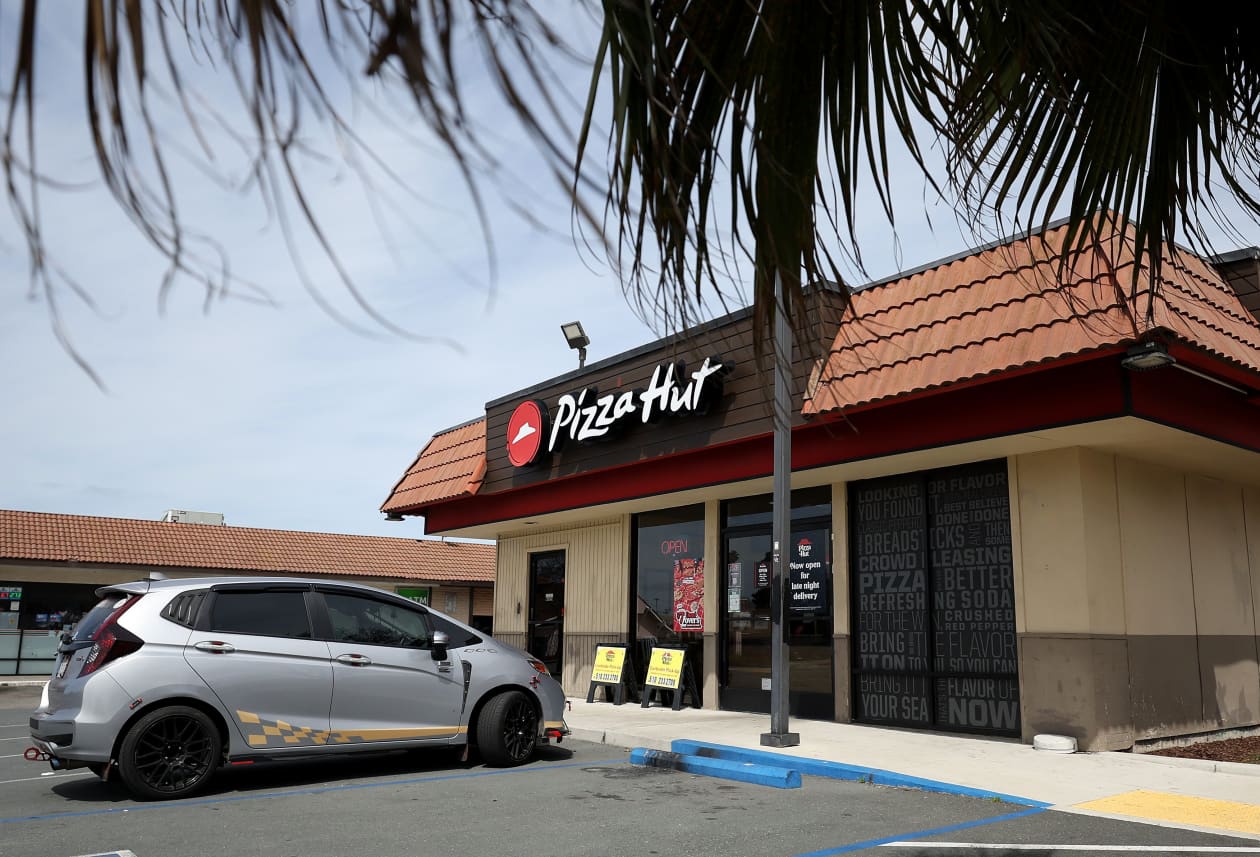
Yum Brands is selling Pizza Hut for $2.7 billion after years of underperformance, as the chain lagged Domino’s and failed to keep pace with the shift to digital ordering. The article frames Pizza Hut as a once-dominant brand that lost innovation leadership after its stuffed-crust heyday in the 1990s. The deal underscores a prolonged decline in the chain’s fundamentals and strategic positioning.
This is less a restaurant turnaround story than a signal that scale without product relevance is now a liability in casual dining. The private-equity exit implies the public market no longer believes incremental advertising or remodel spend can re-accelerate traffic, which should pressure other legacy franchisors with dated formats and weaker digital mix. The second-order winner is not necessarily the pizza category leader only, but any operator with higher delivery frequency, stronger app economics, and better unit-level labor leverage, because customers have already shown they will trade brand heritage for convenience.
The core risk for the buyer is that Pizza Hut’s issues look structural, not cyclical: a weak innovation pipeline, lower digital attach rates, and a format that is less suited to off-premise demand. That means the turnaround window is probably measured in years, not quarters, and the main catalyst would be a simplification of the menu, refranchising, or a smaller store footprint that restores franchisee economics. If those don’t happen, the asset could become a cash-flow harvest rather than a growth story.
Contrarianly, the market may be overstating the death of the brand itself and understating the value of a global, recognizable name in emerging markets and value-led occasions. A private owner can cut legacy overhead faster than a public company and push more aggressive pricing without worrying about near-term margin optics. But the burden of proof is on same-store sales: if the next 2-4 quarters don’t show digital share gains and better transaction trends, the thesis remains one of managed decline rather than reinvention.
AI-powered research, real-time alerts, and portfolio analytics for institutional investors.
Overall Sentiment
strongly negative
Sentiment Score
-0.55
