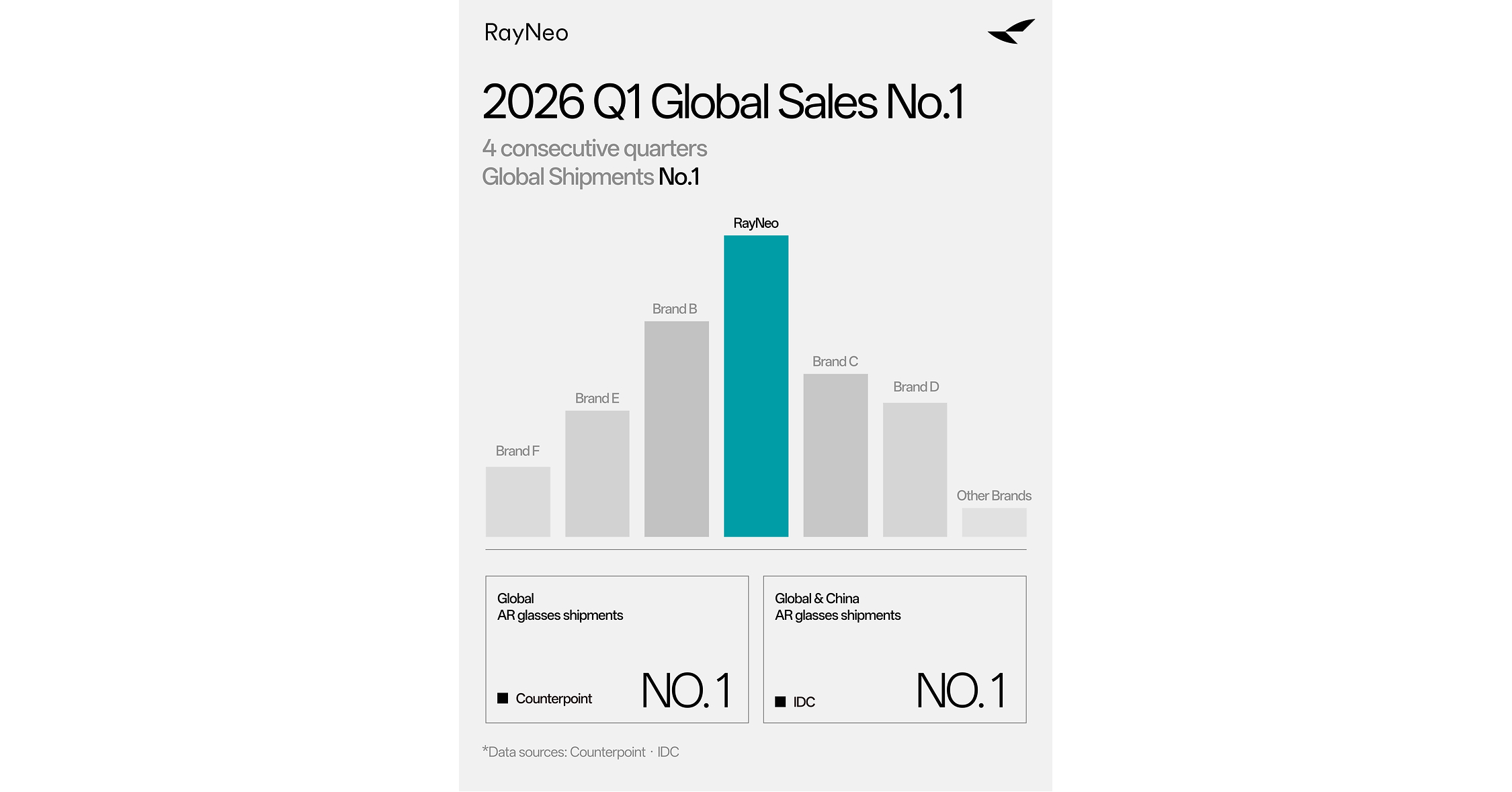
RayNeo claimed the No. 1 spot in global AR smart glasses shipments in Q1 2026, capturing 23.7% market share by shipment volume per Counterpoint. The article cites strong category momentum—global AR smart glasses shipments nearly doubled in 2025—and highlights rapid North America growth with RayNeo shipments up 456.5% YoY in Q4 2025. Overall, the news frames RayNeo’s product roadmap (Air Series upgrades, X3 Pro AI/AR integration) as gaining traction as competition from Meta, Google, Samsung, and Apple intensifies.
The main market signal is not that AR glasses are “working,” but that the category is being commoditized faster than the equity market probably expects. Shipment leadership by a consumer OEM tends to favor whoever owns the silicon, operating system, or distribution rails rather than the brand at the top of a low-ASP market; that points more cleanly to QCOM than to the hardware vendors themselves. If the category is becoming a volume game, margins will likely migrate to component suppliers and platform owners while device makers fight price erosion and obsolescence risk.
For META and GOOGL, the read-through is mixed but constructive in the near term: category validation lowers perceived adoption risk for smart eyewear, yet it also raises the probability of faster competitive response from Chinese and Korean entrants. That matters because the first wave of demand may be “good enough display + AI assistant,” not premium hardware, which compresses the moat around any single consumer-branded device. For AAPL, the risk is not that it loses a current market it doesn’t yet fully serve; it’s that the category’s UX standard gets set by cheaper, faster-moving rivals before Apple arrives, increasing the burden on the eventual launch to justify a premium multiple.
The contrarian point is that shipment share is a weak proxy for economic value here. Without proof of attach rates, ASP, and gross margin, this could be a volume story with very limited earnings impact for public comps over the next 1-3 quarters. If consumer demand is real, the clearest second-order beneficiaries are QCOM and channel partners like AMZN/BBY via incremental accessories and device traffic, but even that is likely too small to move the needle until there is evidence of repeat purchase or replacement cycles.
Catalyst-wise, the next 1-3 months will be about whether Android XR and Ray-Ban style products can show meaningful preorder/retail sell-through outside of China; over 6-18 months, the key is whether smart glasses remain a niche wearable or evolve into a broader smartphone-adjacent platform. The thesis is falsified if upcoming launch data show weak sell-through, if ASPs collapse faster than unit growth, or if Apple’s entry reframes the category as premium-only and slows mass adoption.
AI-powered research, real-time alerts, and portfolio analytics for institutional investors.
Request DemoOverall Sentiment
mildly positive
Sentiment Score
0.35
Ticker Sentiment
