


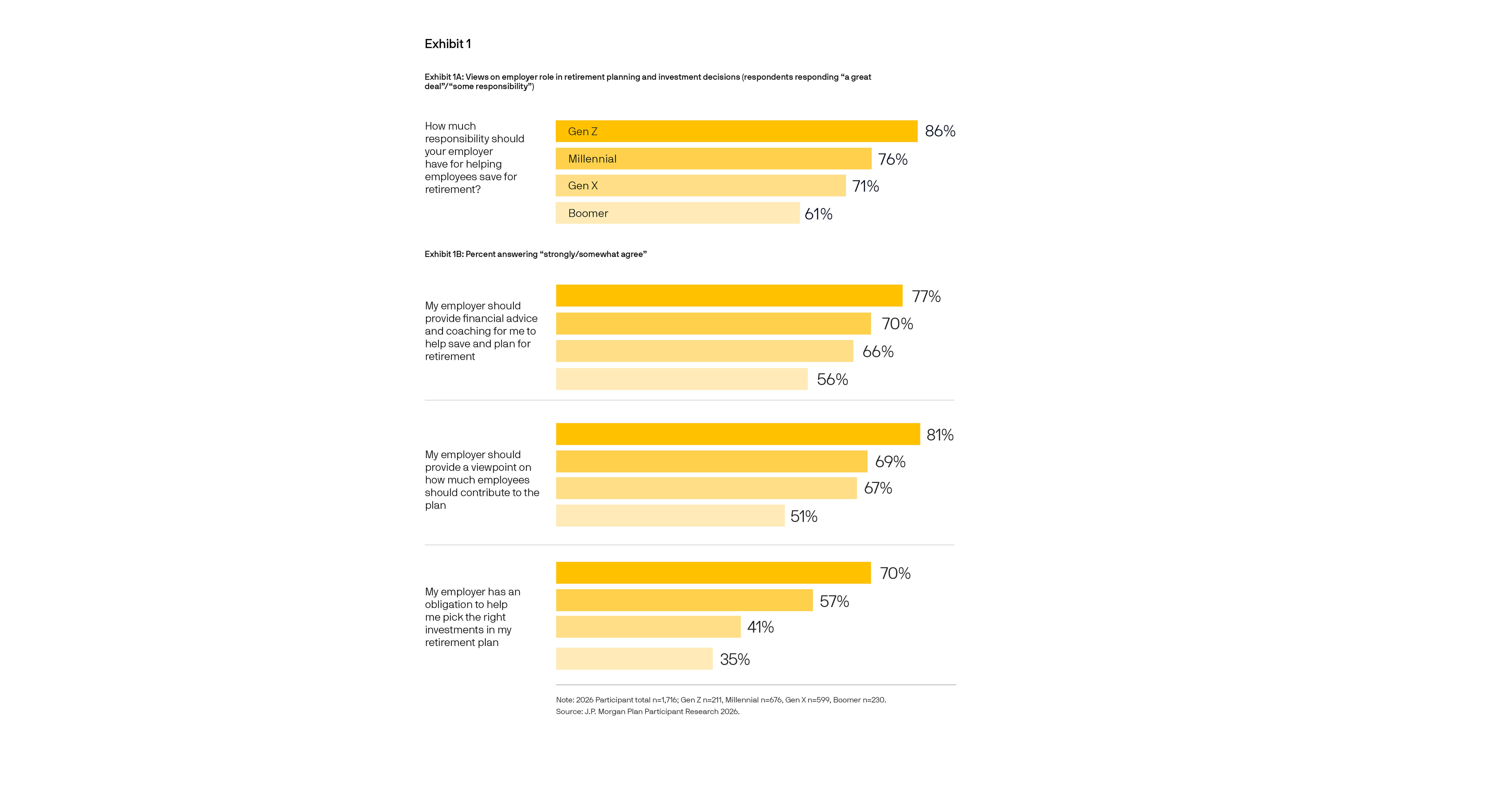
J.P. Morgan Asset Management’s 2026 DC plan survey of 1,716 participants finds 73% want an “easy button” to delegate retirement planning, and 91% are interested in in-plan guaranteed retirement income options (75% would keep assets in-plan if available). It also reports 59% of participants believe they should contribute more and 53% don’t know how much they need to save, while plan design features show high satisfaction (96% of defaulted participants and 97% of auto-escalated contributors). Overall, the release highlights demand for enhanced retirement guidance and decumulation tools rather than any market-moving financial results.
This reads more like a proof-of-demand dataset than an earnings catalyst. The real economic value is not the survey itself but the validation that retirement platforms can charge for decumulation, advice, and defaulting behavior—areas where revenue is steadier and less transactional than accumulation-only asset management. That said, the monetization will likely accrue first to recordkeepers and insurer-wrapped income products, while pure fund managers capture only a portion through target-date, managed account, and model-portfolio shelf space.
The second-order effect is that the retirement stack may shift from a price-competitive mutual fund marketplace toward a more software-like distribution model: whoever controls the default and the paycheck conversion layer can defend flows despite fee pressure. That is constructive for JPM if it can embed itself deeper in workplace plans, but the bigger winners are likely the firms with scale in annuity administration, guaranteed-income wrappers, and advisor integration. For participants, the demand for simplicity also reinforces auto-enroll and auto-escalate economics, which supports sticky contributions but can increase leakage scrutiny when emergency savings are weak.
The contrarian view is that stated demand and actual plan adoption are very different. Employers will move slowly because fiduciary risk, portability, and pricing transparency are still the gating items; many plan sponsors will wait for peer adoption rather than be first movers. So the near-term market impact is probably limited, but over 6-18 months this can support a rerating of retirement-platform franchises if product launches convert into visible AUM, fee retention, or sponsor wins. What would falsify the thesis is continued survey enthusiasm without any pickup in disclosed adoption, net flows, or recurring revenue tied to retirement-income solutions.
AI-powered research, real-time alerts, and portfolio analytics for institutional investors.
Request TrialOverall Sentiment
neutral
Sentiment Score
0.05
Ticker Sentiment
