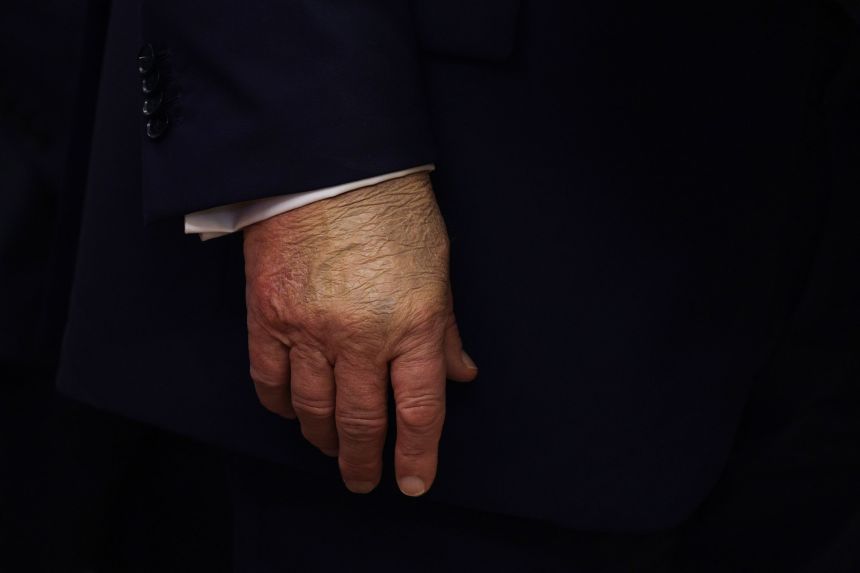
The White House has not released a medical readout from President Trump’s recent physical, breaking from prior practice and heightening scrutiny over his health and fitness for office. The article cites concerns about bruising, leg swelling, a rash, and apparent dozing, while noting Trump’s own claims that everything checked out "perfectly." This is politically relevant but unlikely to have direct market impact, aside from modest sentiment effects around governance and stability.
The immediate market impact is not in any single ticker, but in the policy-volatility premium around the presidency. A vacuum on presidential health disclosure increases the probability of abrupt governance shocks, which tends to widen risk premia in politically sensitive assets: defense, regulated industries, healthcare reimbursement names, and any trade reliant on stable executive functioning. The second-order effect is a higher value for “known continuity” versus “headline continuity,” which can support downside hedges even if the underlying macro data are unchanged.
The more important tradeable signal is the asymmetry between perception management and actual disclosure. When transparency is withheld, markets usually extrapolate toward the worst plausible case, and that overreaction can persist for weeks until a formal readout or visible public reset arrives. That makes the key horizon days-to-weeks, not months: implied vol in election-adjacent macro hedges can reprice quickly, but the unwind can be just as fast if the White House produces a clean medical memo.
Consensus is likely underestimating the behavioral component: health ambiguity can alter legislative bargaining, foreign-policy signaling, and intra-party contingency planning before it shows up in polling. The contrarian view is that the absence of disclosure itself may be a deliberate low-cost way to keep opponents guessing, which means the news flow could be noisy without changing governance capacity. In that case, the correct response is not a directional macro bet, but a focused long-volatility and event-driven posture.
The main risk is a sudden release that is materially reassuring, which would compress the fear premium and punish late hedges. Conversely, any additional visible lapse, hospitalization rumor, or contradictory staff comment would likely extend the repricing and make the move self-reinforcing over 1-4 weeks.
AI-powered research, real-time alerts, and portfolio analytics for institutional investors.
Request TrialOverall Sentiment
mildly negative
Sentiment Score
-0.20
