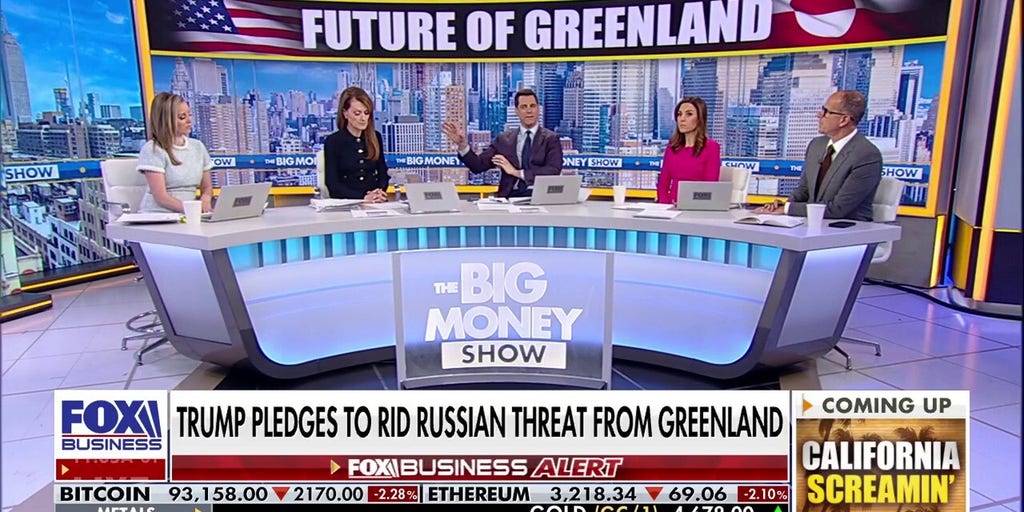
The provided text is a TV programming schedule listing show names and times for Fox Business and Fox News channels and contains no financial data, corporate results, economic indicators, or market-moving information. There is no actionable intelligence for investment decisions or portfolio adjustments.
Market structure: A benign/no-news media day typically compresses information flow and narrows intraday realized volatility by ~10-25% vs active-news days, favoring volatility sellers, cash-rich active managers, and large-cap passive flows (SPY, QQQ). Liquidity becomes shallower—order-book depth can fall 15-30%—so small shocks create outsized moves; commodities and FX (oil, USD) trade more on positioning than fresh fundamentals. Large market-makers gain pricing power in options; small event-driven funds lose alpha without new catalysts.
Risk assessment: Tail risks are concentrated: a single surprise macro print (e.g., CPI m/m >0.4% or payrolls >+300k) or geopolitical flashpoint could trigger 3-6% moves in equities within 48 hours because of compressed liquidity. Immediate (days) risk = gamma squeezes; short-term (weeks) = repositioning into quarter-end flows; long-term (quarters) = trend direction set by Fed messaging. Hidden dependencies include concentrated delta on near-term options and end-of-month ETF rebalances that can amplify moves.
Trade implications: Favor defensive micro-hedges and relative-value trades rather than large directional bets—establish 2-3% protection via SPY 3-5 week put spreads (buy 3% OTM / sell 6% OTM) and 1-2% tactical exposure to VXX calls or short-dated VIX futures for 2-6 week horizon. Implement pair trades: long XLP (consumer staples ETF) vs short XLY (discretionary) for 1-3 months, 1-2% net each, and add 2-3% TLT as a rate-hedge if 10y yield spikes >25bp. Use iron-condors on SPY with 30-day expiries if realized vol stays low (sell 10-delta wings, hedge at 20-delta).
Contrarian angles: Consensus underestimates liquidity fragility; low-news days often precede outsized moves rather than calm continuity—historical parallels: Aug 2019 and Feb 2018 where muted headlines turned into shocks. The apparent opportunity for volatility-selling is therefore asymmetric—short vol gains are steady but vulnerable to single large shocks. Unintended consequence: crowded defensive pairs (XLP/XLY) can become crowded and gap if retail sentiment reverses, so size positions conservatively and use stop thresholds (e.g., cut if XLY outperforms XLP by >6% in 7 days).
AI-powered research, real-time alerts, and portfolio analytics for institutional investors.
Request DemoOverall Sentiment
neutral
Sentiment Score
0.00
