
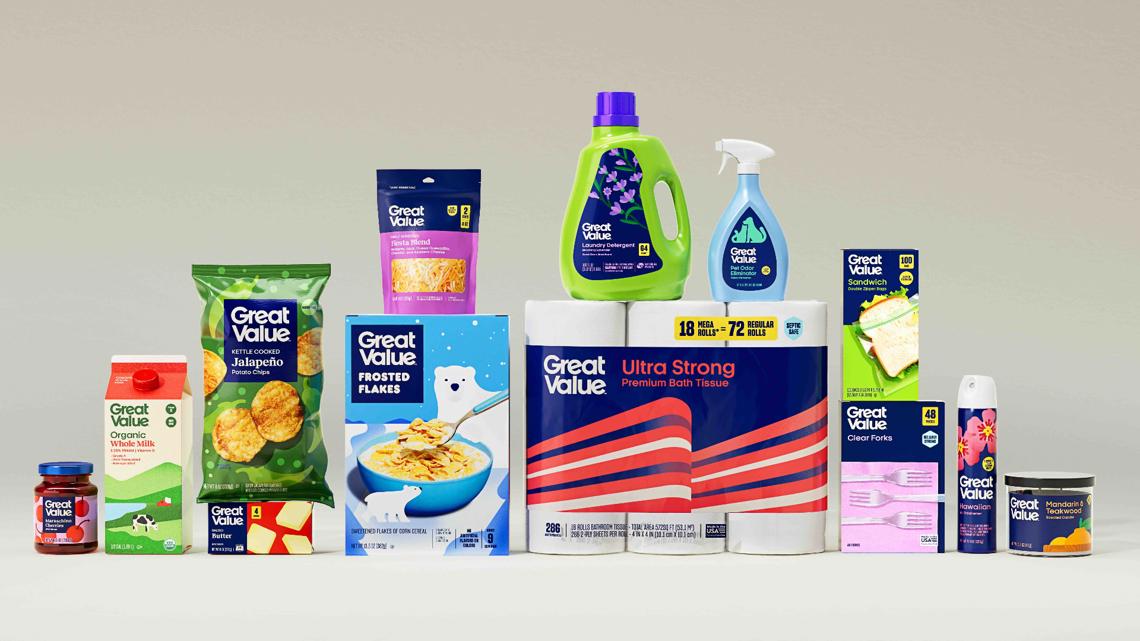
Walmart is rolling out the first full redesign of its Great Value packaging in more than 10 years across 10,000 products, with new labels emphasizing gluten-free, protein, and other key attributes. The company said the changes begin appearing on shelves next month and do not alter the products themselves. The move reflects rising consumer preference for store brands and more ingredient-conscious shopping, but the article does not indicate an immediate financial impact.
This is less about packaging aesthetics and more about Walmart trying to turn Great Value into a higher-conviction conversion engine at the shelf. The key second-order effect is improved search friction: in both physical stores and pickup/fulfillment flows, a cleaner front-of-pack hierarchy should raise the odds that private label wins the first click or first grab, which matters more in a margin-stressed consumer environment where shoppers are trading down but still want “health halo” cues. That supports Walmart’s mix and basket size more than headline unit growth, because store brands typically carry structurally better economics than national brands.
The competitive pressure lands hardest on mid-tier CPGs that rely on visually cluttered packaging and weak brand differentiation. If Walmart’s redesign makes Great Value feel closer to national brands, the real loser is not premium incumbents but mainstream branded food manufacturers that already face private-label share creep and now risk losing even more of the “good enough” occasion. There’s also a supply-chain angle: consistent nutrient callouts and stronger product imagery reduce picker error and substitution friction, which should modestly improve online order accuracy and lower labor waste over time.
The market may be underestimating how much this is a merchandising lever rather than a brand refresh. If Walmart can lift private-label attachment even 20-30 bps across a quarter of U.S. sales, the earnings impact can compound through gross margin and basket composition without needing any unit inflation. The risk is that packaging changes are easy to imitate and can be noise if consumers interpret them as cosmetic rather than substantive; if private-label adoption stalls as inflation normalizes, the benefit fades over 6-12 months.
Contrarian view: the bigger winner may be Walmart’s fulfillment economics, not its grocery P&L. Anything that reduces cognitive load for shoppers and pickers can improve order velocity, substitution rates, and labor productivity, which is harder for the market to model than a simple private-label share story.
AI-powered research, real-time alerts, and portfolio analytics for institutional investors.
Request TrialOverall Sentiment
neutral
Sentiment Score
0.10
Ticker Sentiment
