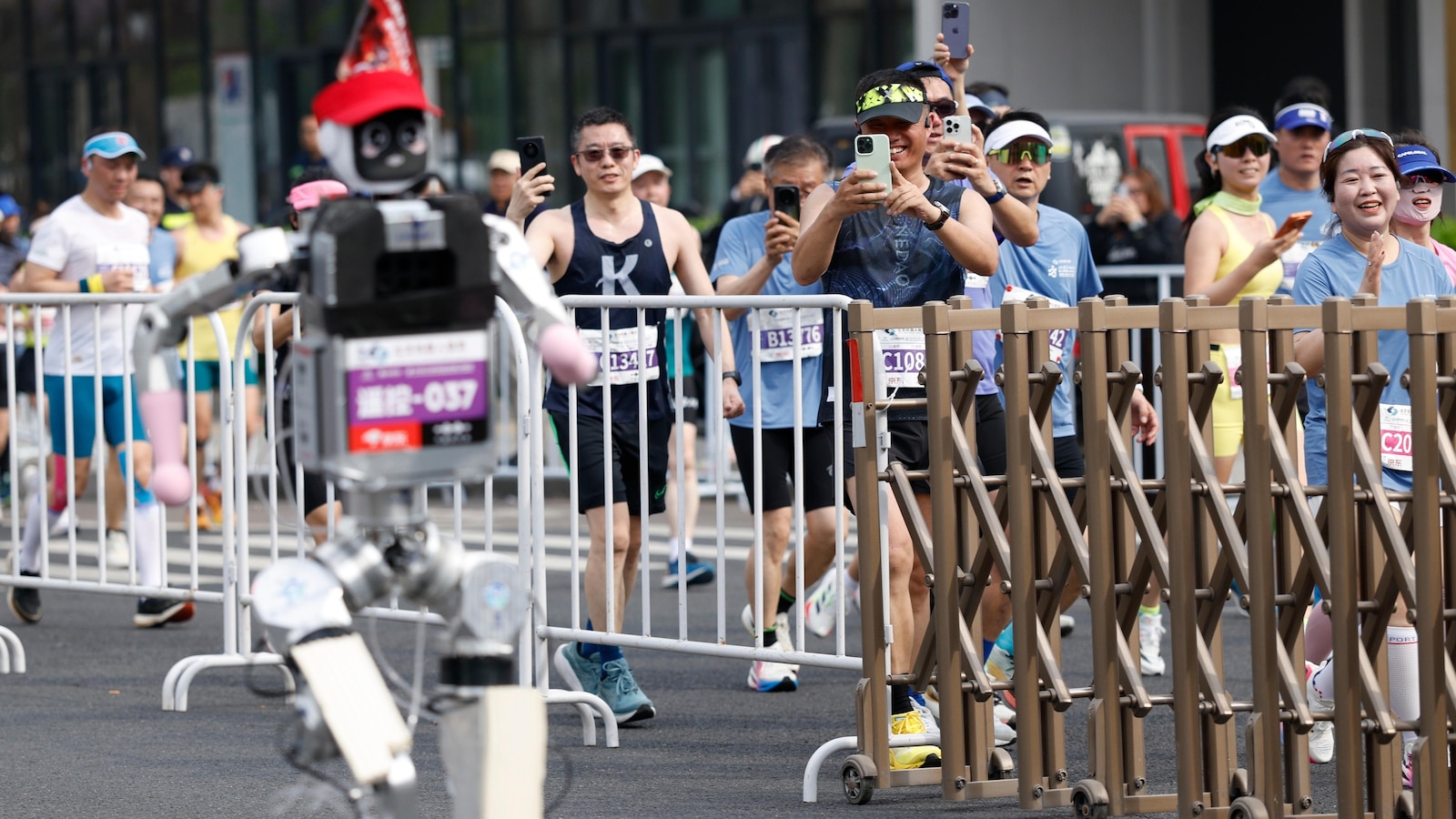
A humanoid robot from Honor completed a Beijing half-marathon in 50 minutes and 26 seconds, beating the human world record of about 57 minutes and dramatically improving on last year’s robot winning time of 2 hours, 40 minutes, 42 seconds. Beijing E-Town said roughly 40% of robots navigated autonomously, highlighting rapid progress in embodied AI and robotics. The event underscores China’s push to accelerate humanoid robot development, but the immediate market impact is likely limited.
This is less a “robot story” than a signal that China is compressing the iteration cycle in embodied AI from lab demo to controlled endurance benchmark. The key second-order effect is not consumer adoption yet; it is industrial learning rate: gait control, battery density, thermal management, actuator durability, and lightweight materials all get stress-tested in public, which should accelerate vendor differentiation over the next 6-18 months. The winners will be the companies with full-stack integration across hardware, control software, and manufacturing, because endurance events expose weak links that don’t show up in short demos.
The more important market implication is that China is turning humanoids into a strategic procurement category, not just a robotics niche. That should support domestic supply chains in precision reducers, servo systems, force sensors, machine vision, and edge compute, while pressuring imported peers that rely on expensive Western components. If the quoted shipment figures are directionally correct, the bigger opportunity is not the headline robot makers alone but the component stack where volume can scale faster and margins may be better preserved.
Near term, the risk is overextrapolation: public competition performance does not equal factory uptime, payload, or unit economics. Over the next 3-9 months, any field failure, battery degradation issue, or safety incident could reset sentiment hard because these names will trade on narrative confidence more than current earnings. The contrarian view is that the market may already be discounting too much commercialization too early; the real monetization inflection likely sits 2-4 years out, after costs fall and enterprise customers demand repeatable ROI rather than spectacle.
AI-powered research, real-time alerts, and portfolio analytics for institutional investors.
Request DemoOverall Sentiment
mildly positive
Sentiment Score
0.35
