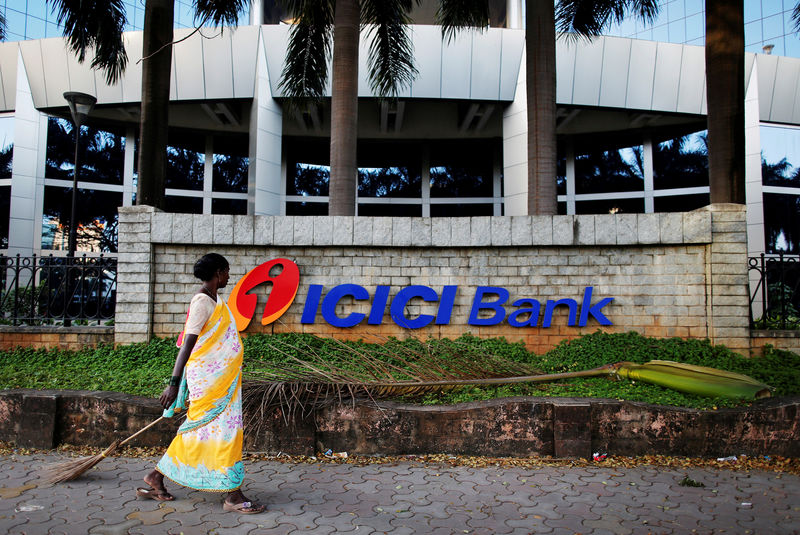
ICICI Bank reported Q4 FY2026 profit after tax of INR137 billion, up 8% year over year and 21% quarter over quarter, and 11% above Nomura's estimate. The beat was driven by lower credit costs at 3 bps versus the firm's 42 bps forecast and stronger net interest income, while fee income stayed soft; NII was 1% ahead and NIMs held at 4.2%. Nomura raised its target price to INR1,620 from INR1,535 and kept a Buy rating.
The immediate read-through is that the franchise is still compounding faster than the market expected, but the quality of the beat matters more than the beat itself: credit costs near zero while loan growth reaccelerates is the rare combination that can keep consensus revisions positive for another 1-2 quarters. That typically supports multiple stability rather than rerating, because the market starts to price the earnings stream as less cyclical and more fee-sensitive. The soft fee line is the main reason this is not a straight-line bull case; if deposit franchises tighten, the bank may have to choose between preserving margins and defending growth.
Second-order, the real beneficiaries are not just the bank itself but the broader Indian financial complex. Strong large-bank lending growth usually pulls through better funding access for smaller lenders and NBFCs, but it can also pressure them on spreads if the largest balance sheets stay aggressive on pricing. If ICICI keeps growing loans at this pace with high liquidity coverage, it can take incremental share without stretching its funding profile, which is negative for less liquid peers that depend more on wholesale funding.
The key risk is that this quarter may be a near-peak mix of benign credit and one-off margin support. If deposit competition intensifies over the next 6-12 months, net interest margin expansion will likely lag loan growth, and the market will stop paying up for “clean” earnings once credit normalization resumes from these unusually low levels. The contrarian view is that the stock may not be obviously cheap on headline valuation, but the consensus is probably underestimating how long a high-quality bank can stay expensive when ROE remains mid-teens and asset quality does not deteriorate.
For trading, this is a better relative-value long than an outright chase: the setup favors owning the highest-quality Indian private bank versus lower-quality financials rather than trying to front-run a large absolute rerating. The asymmetry improves if near-term pullbacks are driven by skepticism around fee income or NIMs, because those are fixable over 2-4 quarters, while loan growth and credit discipline are the harder-to-replicate advantages.
AI-powered research, real-time alerts, and portfolio analytics for institutional investors.
Request DemoOverall Sentiment
mildly positive
Sentiment Score
0.45
Ticker Sentiment
