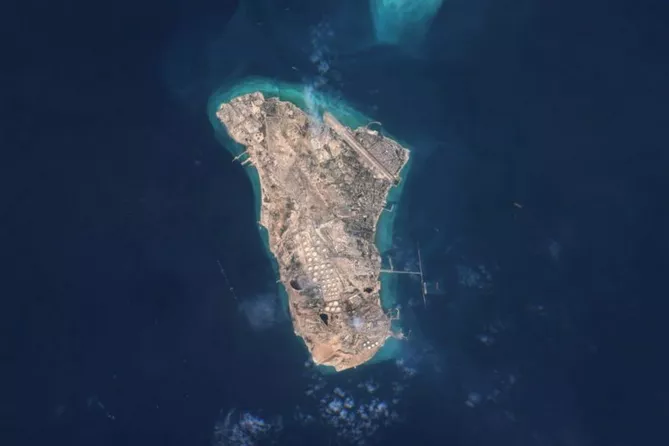
Kharg Island facilitates as much as 90% of Iran's oil exports; White House advisor Jarrod Agen publicly vowed to seize Iran's oil reserves and discussions include a potential US move to take control of the island. Reports also indicate President Trump has privately signaled interest in deploying small ground units to conduct strategic operations in Iran. Such actions would materially threaten Iranian export capacity, choke government revenues and likely trigger higher oil prices and elevated market volatility, particularly across energy and emerging-market assets.
A credible attempt by an external actor to seize or operate a major Gulf export node would immediately translate into a sizable “war-risk” premium priced into crude and tanker markets — think a 7–15% Brent shock within 3–10 trading days if physical flows are even intermittently disrupted. Beyond headline barrels, expect insurance costs and VLCC/Suezmax timecharter rates to spike, adding $2–6/ bbl of effective delivered cost for marginal barrels until routes and insurance markets adjust.
Operational control is not the same as reliable exports: technical staff, spare parts, insurance coverage and buyer willingness create a multi-month frictional wedge between physical control and sustained sales; realistically, unilateral restart of full export capacity would take 3–12 months and could be uneven by grade/destination. That timeline creates a window where spare production and inventory management (OPEC spare + SPR) are the market’s clearing levers — a coordinated SPR release could cap the peak within ~60 days, while absence of coordination raises tail-risk for prolonged $100+ outcomes.
Second-order winners: firms with latent spare production or hedged barrels (US E&P and integrated majors with downstream optionality), tanker owners and P&I/war-risk insurers, and defense/infra providers contracted for logistics and port security; losers: refiners dependent on discounted Gulf crude, regional trading houses, and sovereign balance sheets that rely on uninterrupted export revenue. Currency and sovereign-credit stress in exporting states would surface within weeks, amplifying credit and EM vol.
Market consensus is likely to overshoot on permanence: operational realities make full privatization or sustained control politically and technically costly. That argues for buying event-driven volatility (short-dated calls and shipping exposure) rather than taking large directional, long-duration crude positions — the most attractive risk/reward is playing the convexity around short-term disruption and insurance/dayrate re-pricing rather than base-case supply destruction.
AI-powered research, real-time alerts, and portfolio analytics for institutional investors.
Request DemoOverall Sentiment
strongly negative
Sentiment Score
-0.72
