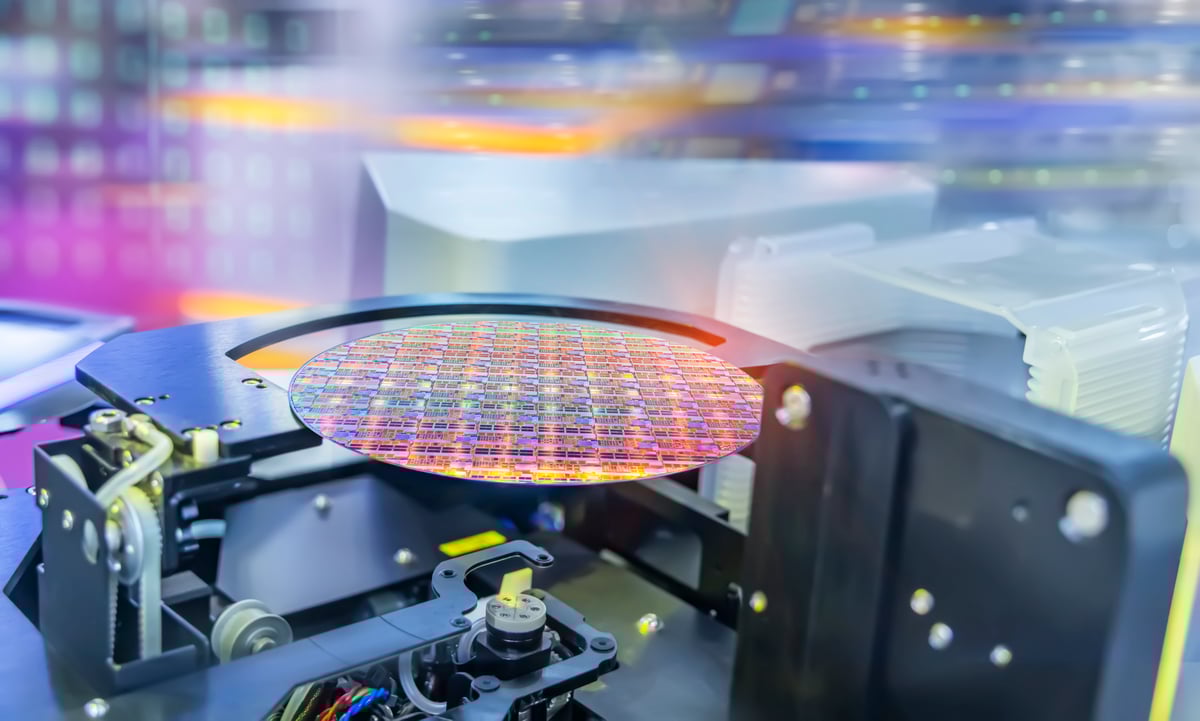
Taiwan Semiconductor (NYSE: TSM) is presented as a primary beneficiary of the AI-driven demand surge, with management expecting AI chip demand to grow at a mid-40% CAGR and the company expanding fab capacity to meet that demand. TSMC’s gross margin has improved from 46.3% in 2019 to 56.1% last year, it may raise prices 3–10% in 2026, and 2nm processing is priced roughly 50% above 3nm; the stock trades at about 22x 2026 analyst earnings estimates, underpinning a bullish investment case.
Market structure: TSMC (TSM) is the primary beneficiary of secular AI-driven demand for high-performance compute; expect TSM revenue growth aligned with a mid-40% CAGR in AI chips over the next 3 years, supporting gross margins >55% if utilization stays >85%. Winners include GPU/ASIC designers (NVDA, AMD, GOOGL) that outsource fabs; losers are legacy integrated players (INTC) and any fab with persistent yield/scale issues. Supply tightness for EUV tools, specialty gases (neon/helium) and substrate materials will keep pricing power intact near-term but invites capex-led capacity increases.
Risk assessment: Tail risks are geopolitical (China-Taiwan escalation), export-control shocks, or a 2nm yield failure; probability low but portfolio-impact high (30–60% drawdown scenario for TSM within 0–12 months). Short-term (days–months) volatility driven by weekly order revisions and ASML deliveries; long-term (quarters–years) depends on CHIPS Act-capacity shifts and potential oversupply if fab buildouts accelerate beyond demand (breakeven utilization risk). Hidden dependencies include ASML tool cadence, Taiwan utilities/water constraints, and customer concentration (Nvidia share >30% of advanced-node wafers).
Trade implications: Implement a staged long: establish 2–3% portfolio weight in TSM now, add to 4–6% if price drops 10–15% within 90 days or forward P/E compresses to ~18x (implies ~18% downside from current 22x). Pair trade: go long TSM and short INTC (dollar-neutral 2:1 size) to capture foundry moat; buy 12–18 month LEAP calls 25–35% OTM on TSM to lever secular upside, finance with 3-month OTM call sales. Rotate +2–4% into semiconductor equipment names (ASML, LRCX, AMAT) over 60–120 days; cut legacy CPU exposure by 50% within 6 months.
Contrarian angles: Consensus underestimates onshoring risk—US/Europe subsidies could divert ~10–15% of near-term advanced-node demand away from TSM over 2–4 years. Market may be underpricing geopolitical insurance; consider buying ~6–9 month TSM put spreads sized to not exceed 1% portfolio cost if Taiwan tensions spike. Historical parallel: memory booms show rapid capex overshoot; similar overbuild in logic/process nodes can compress margins by 500–800 bps if demand softens.
AI-powered research, real-time alerts, and portfolio analytics for institutional investors.
Request DemoOverall Sentiment
moderately positive
Sentiment Score
0.65
Ticker Sentiment
