

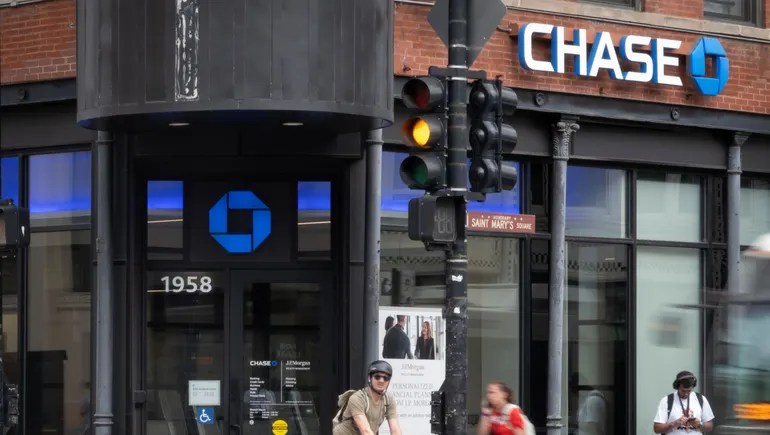
JPMorgan estimates it would need about $20 billion more in capital under recent U.S. regulatory reproposals, including a roughly 4% increase in required common equity tier 1 capital, driven by a $130 billion rise in risk-weighted assets. Executives said the U.S. G-SIB surcharge remains miscalibrated and could raise surcharges meaningfully for large banks, potentially increasing JPMorgan’s cost of credit relative to non-G-SIB peers. Separately, the bank said it is testing Anthropic’s Mythos AI model and warned that AI has made cyber risk harder to manage.
The key market implication is not the headline capital number, but the direction of travel: if the largest U.S. bank is absorbing a high-single-digit capital uplift while already running at the floor on stress-buffer relief, incremental regulatory tightening mostly converts into lower balance-sheet elasticity rather than a near-term earnings hit. That disproportionately matters for businesses with the highest capital intensity per dollar of revenue: market-making, financing, and secondary trading. In practice, this shifts marginal flow toward non-G-SIB competitors over the next 6-18 months, especially in products where client stickiness is lower and pricing is transparent.
The second-order effect is a likely widening of the funding and execution spread between systemically important banks and everyone else. If JPM chooses to defend ROE, it will need to reprice select lending and markets activities, which can raise all-in client costs without showing up immediately in reported NII. That creates a slow-burn competitive opening for regional banks and nonbank liquidity providers, while also making capital-light fee businesses relatively more attractive inside the G-SIB complex.
The contrarian angle is that the market may be overestimating the probability that these proposals land exactly as written. The political incentive is to avoid a ruleset that visibly handicaps U.S. market depth or pushes activity offshore, so the first-round estimate may be more of a negotiating anchor than a final outcome. That means the cleaner trade is not a blanket short on JPM, but a relative-value expression against banks whose upside depends on the largest institutions being constrained longer than expected.
Cyber/AI is a different but relevant catalyst: management is signaling a rising security burden, which means some of the capital saved by any eventual rule softening could be redirected into control infrastructure rather than higher payouts. Over the next few quarters, that argues for sustained opex pressure across big banks, but not a broad sector derating unless a real incident proves the risk is systemic. In the meantime, the market should continue to favor scale in compliance spending, which is a subtle advantage for incumbents with the best engineering budgets.
AI-powered research, real-time alerts, and portfolio analytics for institutional investors.
Request TrialOverall Sentiment
mildly negative
Sentiment Score
-0.15
Ticker Sentiment
