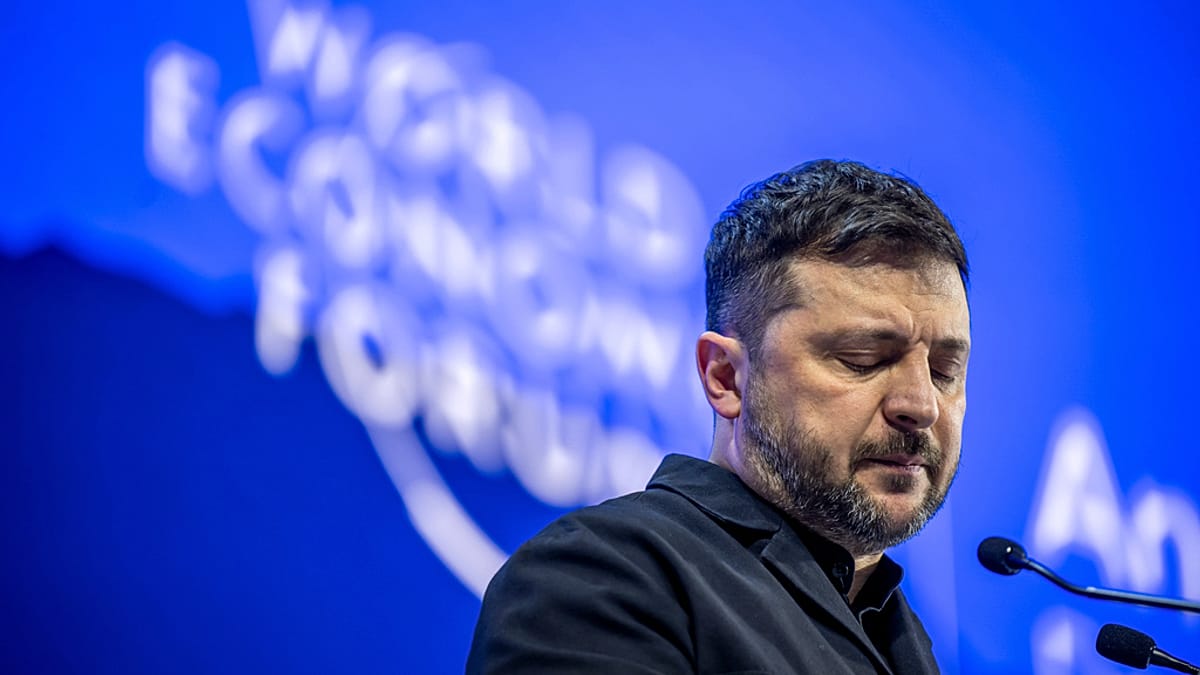
At Davos President Volodymyr Zelenskyy sharply criticised European inaction on defence and urged stronger US involvement, saying postwar security guarantees are nearly ready but require Washington’s backing. He questioned token troop deployments to Greenland, proposed more aggressive measures against Russian shipping and missile supply chains, and decried Europe's failure to seize Russian assets or act over Iran’s crackdown. The comments underscore persistent geopolitical risk that supports potential upside for defence spending and sanctions-driven moves in energy and commodities markets while signalling continued political uncertainty that could pressure risk assets.
Market structure: A protracted perception of European political fragmentation benefits US defense primes and exchange-traded exposure to aerospace/defense (pricing power on munitions, 10–30% margin expansion potential on sustained demand) while weighing on European cyclical sectors and sovereign credit. Energy and shipping remain bifurcated: successful extractions/seizures of Russian oil would cut supply and lift Brent 10–25% over months; failure/continued shadow fleet flows keeps downward pressure on spot but raises geopolitical risk premia.
Risk assessment: Tail risks include a NATO-Russia incident or US unilateral seizures triggering commodity shocks or secondary sanctions; probability low (<15%) but impact severe (oil +30%+, risk-free rate shock). Near-term (days–weeks) expect headline-driven volatility; medium (3–12 months) expect rearmament capex and sanctions-driven supply-chain reorganization; long-term (1–3 years) could see structural defense supply chain onshoring and higher European fiscal deficits.
Trade implications: Favor US defense exposure, USD and gold as hedges, and directional commodity optionality on oil/gas. Implement concentrated, time-limited plays (3–12 months) rather than buy-and-hold: buy defense call spreads, long U.S. dollar via ETF, and long gold in small size; short European macro-sensitive beta (regional banks, cyclicals) via ETFs or put spreads to capture fragmentation premium.
Contrarian angles: Consensus exaggerates permanent EU impotence — an incremental shock (energy cutoff or public backlash) could trigger rapid EU fiscal/defense integration benefiting European defence suppliers (Airbus supplier tier, MBG-like names) over 12–36 months. The market may underprice asymmetry: a targeted policy action that freezes Russian revenue would be disinflationary for energy-importing EMs but inflationary in Europe, producing idiosyncratic sectoral winners and losers.
AI-powered research, real-time alerts, and portfolio analytics for institutional investors.
Request DemoOverall Sentiment
moderately negative
Sentiment Score
-0.45
