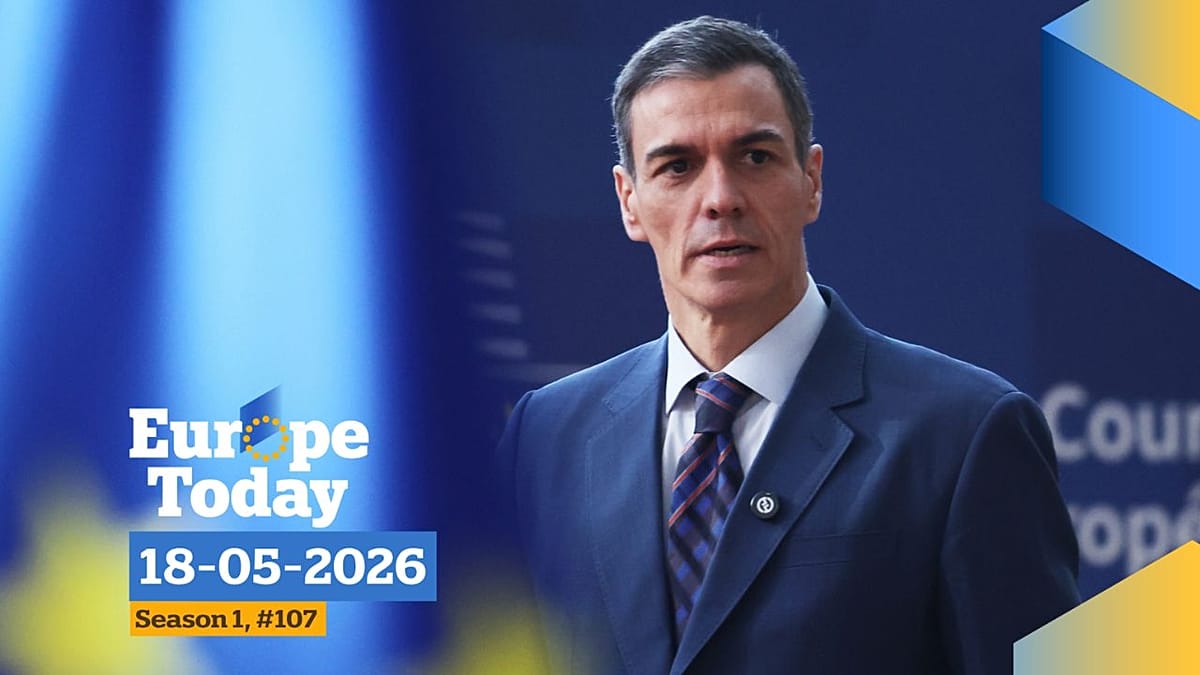
Spain’s Socialist Party lost regional elections in Andalusia, increasing pressure on Prime Minister Pedro Sánchez and highlighting the likelihood of a conservative People’s Party government relying on far-right support. The article also notes a deadly drone strike on Moscow that killed 4 people and injured dozens, while the WHO declared a global health emergency over an Ebola outbreak in the Democratic Republic of Congo. The rest of the piece is largely program promotion for Euronews' Europe Today, with limited direct market relevance.
The immediate market read-through is not about Spain per se but about the re-pricing of European political risk premia. A harder-right governing coalition in a major euro-area economy raises the odds of fiscal slippage, weaker reform execution, and more confrontational rhetoric toward Brussels, which tends to lift dispersion across EU sovereign spreads and depresses risk appetite for domestic cyclicals tied to public investment. The second-order effect is that policy uncertainty becomes a discount-rate problem for Spanish banks, utilities, and infrastructure names rather than an earnings problem.
The bigger strategic issue is contagion into the broader European election calendar: once a center-left incumbent is seen losing control of the narrative, investors start to price a higher probability of coalition fragmentation elsewhere, which supports defensives, cash-generative exporters, and non-EU revenue streams. That said, this kind of move often overshoots in the first 1-2 weeks because markets tend to extrapolate a national vote into a regime change; if coalition talks remain orderly and Madrid keeps EU budget discipline, the risk premium can fade just as fast.
On the geopolitical side, the Moscow drone strike is less important for immediate battlefield economics than for signaling escalation capacity and domestic vulnerability. It increases the probability of asymmetric retaliation and raises tail risk around energy infrastructure, which can keep a floor under European gas and defense names for several months even if crude itself stays range-bound. The Ebola emergency is a smaller near-term macro issue, but it can still re-open the trade in global health and diagnostics as procurement cycles accelerate over the next 3-6 months.
The contrarian view is that the market may be overpricing headline risk from Spain while underpricing the durability of the broader pro-risk European policy backdrop. If Brussels treats the outcome as localized rather than systemic, any spread widening should be a fade rather than a trend. The best setup is to express that via relative value rather than outright directional macro exposure.
AI-powered research, real-time alerts, and portfolio analytics for institutional investors.
Request DemoOverall Sentiment
neutral
Sentiment Score
-0.10
