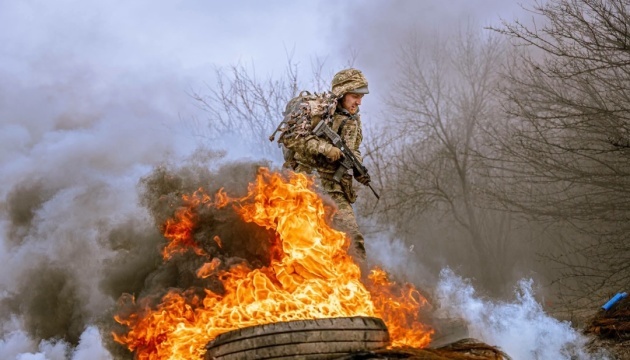
Russia’s spring offensive is described as failing to produce a breakthrough, with territorial gains slowing to roughly 155 square kilometers from March to April and April expected to stay near 150 square kilometers. The article says Russian losses remain very high at about 200 personnel per square kilometer gained, underscoring an attritional strategy that is not delivering operational results. Key May focus areas are expected to be Hulyaipole, Pokrovsk–Myrnohrad, Kostiantynivka, and Kupiansk, with continued pressure along the border regions.
The market implication is not a binary war-end signal; it is a duration trade. The key second-order effect is that Russia appears to be spending manpower faster than it can convert it into durable territorial control, which raises the probability of a prolonged, lower-velocity conflict rather than a sudden escalation to decisive maneuver warfare. That tends to favor assets tied to sustained Western support, replenishment cycles, and wartime industrial capacity over any short-dated expectation of a negotiated de-escalation.
The more interesting positioning nuance is on defense supply chains: when an attacker shifts toward infantry-plus-drone tactics, demand becomes less concentrated in high-end platforms and more durable in low-to-mid complexity systems, electronics, optics, counter-UAS, EW, munitions, and repair/maintenance. That creates a mixed basket effect where primes benefit from budget persistence, but the best risk/reward may sit in suppliers that can scale volume without needing new program awards. The biggest beneficiary is not necessarily the headline defense names, but the names with visible backlogs and constrained capacity.
The main tail risk is a policy shock, not a battlefield shock. If Russia can partially offset losses with a mobilization or coercive financing push over the next 1-2 quarters, the attrition thesis stretches out and keeps defense demand elevated; if Western aid or production bottlenecks slow, the market could temporarily underprice the probability of localized Russian gains despite the strategic drag. Consensus is probably underestimating how long a stagnant front can still support high burn rates in munitions and ISR, while overestimating the chance that tactical stagnation quickly translates into macro resolution.
AI-powered research, real-time alerts, and portfolio analytics for institutional investors.
Request DemoOverall Sentiment
mildly negative
Sentiment Score
-0.15
