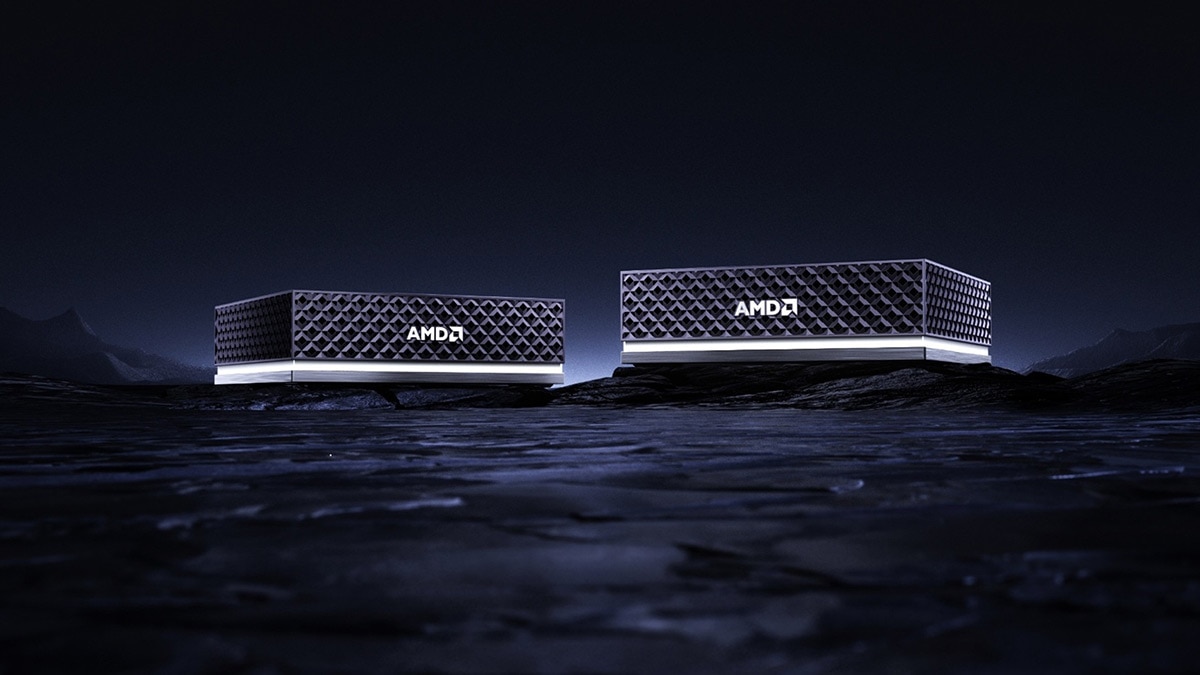
AMD announced Ryzen AI Halo and Ryzen AI Max PRO 400 Series processors aimed at local agentic AI workloads, with Ryzen AI Halo pre-orders starting in June 2026 and commercial availability for Ryzen AI Max PRO 400 Series in Q3 2026. The new platforms support up to 200 billion-parameter models locally on Halo and up to 300 billion-parameter models on Ryzen AI Max+ 495 PRO systems, with as much as 192GB unified memory and 160GB VRAM. The launch strengthens AMD's position in AI PCs, workstations and OEM ecosystems, but the announcement is largely product-roadmap driven rather than immediately financial.
AMD is trying to own the “local inference” layer before cloud economics fully reprice agentic workloads. The strategic significance is not the raw TOPS headline; it is that AMD is packaging memory capacity, CPU/GPU/NPU integration, and software portability into a developer-to-enterprise funnel that can turn design wins into a multi-year workstation refresh cycle. If agents become memory-bound rather than FLOPS-bound, AMD’s unified-memory architecture becomes a stronger differentiator versus discrete-GPU centric incumbents and pure CPU vendors.
The second-order effect is a potential procurement shift: enterprises that currently prototype in the cloud may move experimentation onto endpoint systems to reduce latency, data exposure, and token spend. That is incremental demand for premium commercial PCs and mobile workstations, but it is also a margin-pressure story for cloud AI providers if even a small share of iterative inference and fine-tuning migrates on-device over the next 12-24 months. The main beneficiaries beyond AMD are OEMs with enterprise distribution and services attach; HPQ and Lenovo can sell higher ASP systems, but the bigger value accrues to whichever vendor can own fleet refresh contracts tied to AI readiness.
The market may underappreciate how quickly this can cannibalize discrete GPU attachment in some workstation segments. If a single socket platform can satisfy enough local model size requirements, buyers may delay or skip midrange GPU upgrades, pressuring the mix for add-in-board vendors and narrowing the upgrade cycle for professional graphics. The counterpoint is execution risk: software ecosystem support, driver stability, and real-world thermals will determine whether this is a credible production platform or just a benchmark-driven announcement; that makes the next two quarters of OEM validation and developer adoption the key catalyst window.
Contrarian view: the headline is bullish, but the near-term revenue impact is probably modest versus the narrative value. The stock could still rerate if investors start pricing AMD as an endpoint AI platform rather than a datacenter-only beneficiary; however, if pre-orders and OEM shipments are thin, the market may fade the move quickly. The key tell will be whether this launches a repeatable enterprise SKU cycle in 2H26, not whether it can run very large models in a demo environment.
AI-powered research, real-time alerts, and portfolio analytics for institutional investors.
Request DemoOverall Sentiment
moderately positive
Sentiment Score
0.62
Ticker Sentiment
