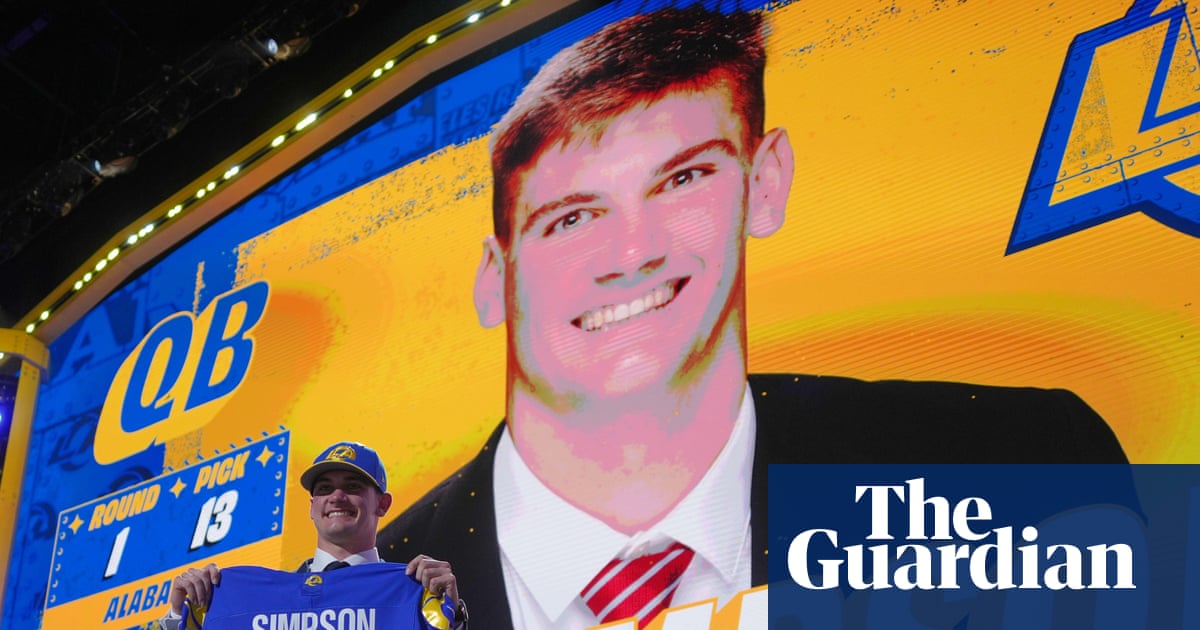
The article is a draft-analysis recap of NFL first-round picks, highlighted by the Rams taking Alabama QB Ty Simpson at No. 13, the Cowboys selecting safety Caleb Downs and edge rusher Malachi Lawrence, and the Jets adding David Bailey, Kenyon Sadiq and Omar Cooper Jr. It frames the Rams' pick as a major reach but potentially a long-term successor play for Matthew Stafford, while praising Dallas and New York for adding speed and versatility. The piece is commentary on team strategy rather than market-moving financial news.
The market is underpricing how much the Rams’ QB choice is really a bet on extending the franchise’s option value, not solving the position today. That matters because teams in their late-window phase often overpay for short-term certainty; here they’ve instead chosen a cheap-enough developmental path with a potentially large embedded call option on Stafford’s eventual exit. The second-order effect is that the Rams’ 2026-27 roster construction can remain aggressive at premium spots, because they may have avoided needing to spend future high capital on quarterback.
The main risk is not just whether the rookie fails, but whether he fails before he gets enough reps to develop. That creates a nasty asymmetry: his value is highest if he sits for 1-2 years, yet his learning curve likely requires live NFL exposure, so the “developmental window” could be functionally wasted. If Stafford stays elite and healthy, this pick may never be stress-tested until the team is already forced into a transition, which means the downside is a delayed quarterback cliff rather than immediate roster drag.
Dallas’ defensive haul is more actionable from a team-building lens because hybrid secondary value is still being mispriced. The league keeps trying to force premium safety/slot talent into old valuation buckets, which leaves an exploitable inefficiency: players who create multiplicative coverage+pressure effects can swing a defense faster than edge-only prospects. If these picks hit, the Cowboys’ defense should improve disproportionately versus modest cap outlay, which is exactly the kind of roster turn that can compress team variance over the next 12-24 months.
The broader draft signal is that the league is still prioritizing trench insulation over skill-position volatility, but that consensus can flip quickly if the top linemen underperform early. The real contrarian angle is that the market may be overconfident in ‘safe’ offensive line investments and underestimating how much immediate NFL value comes from explosive defenders and mismatched offensive weapons. If the linemen look merely average by midseason while the faster, toolsy players generate splash plays, the valuation debate will swing hard in favor of speed and disruption.
AI-powered research, real-time alerts, and portfolio analytics for institutional investors.
Request DemoOverall Sentiment
neutral
Sentiment Score
0.10
