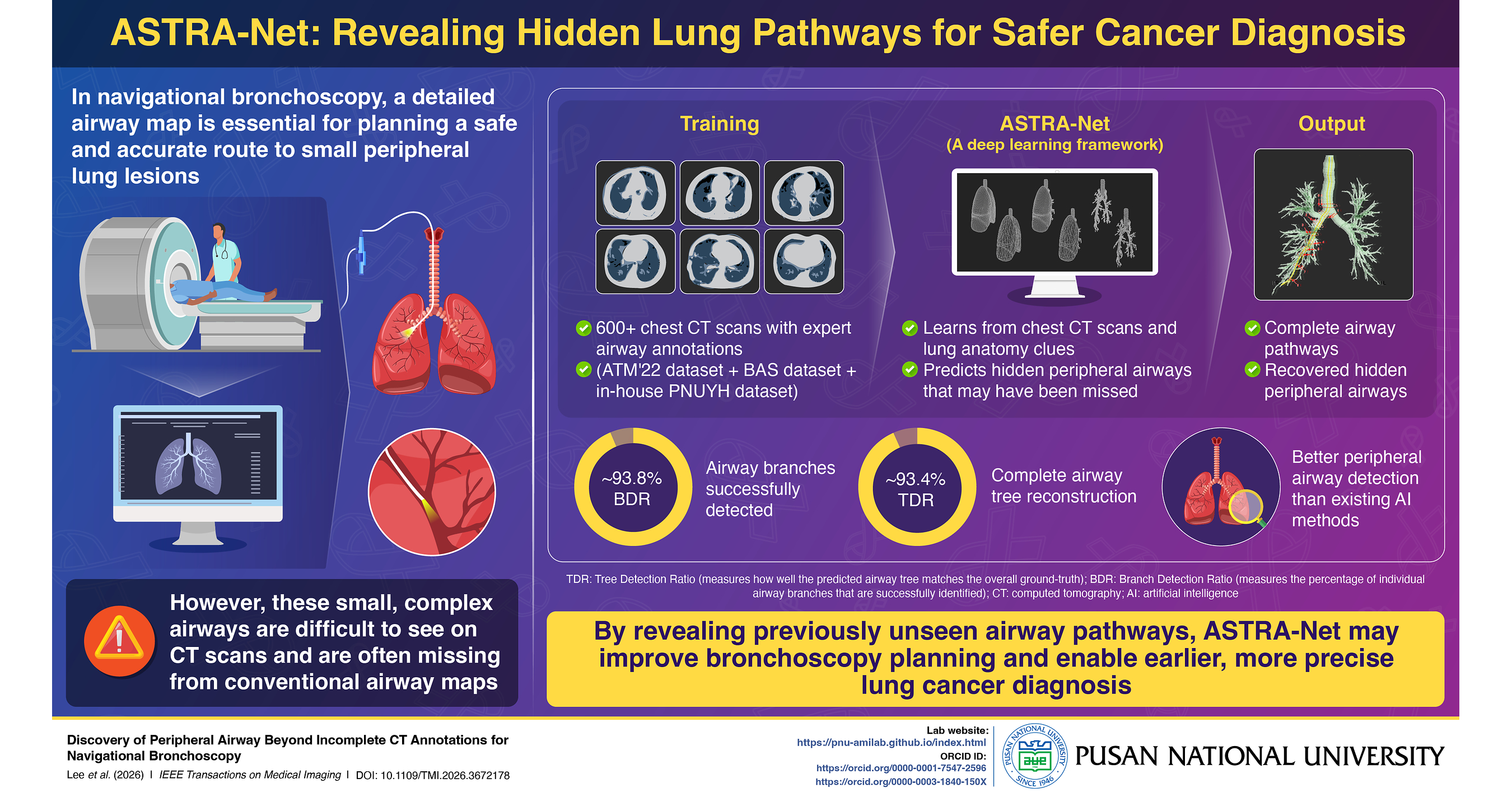
Pusan National University introduced ASTRA-Net, an AI framework for anatomical segmentation that aims to recover peripheral lung airways missing from incomplete CT annotations, enabling more complete 3D airway maps for bronchoscopy navigation. The study (IEEE Transactions on Medical Imaging, June 1, 2026) reports strong performance across multiple datasets and clinical CT scans with varying image quality and slice thickness, with some initial “false positives” reclassified as genuine omitted airway branches. The work is positioned to improve navigation to difficult-to-reach lung lesions and support future AI-assisted/robotic bronchoscopy systems.
This is more a workflow-improvement signal than an immediate earnings catalyst. The economic value sits in better procedure yield and fewer repeat biopsies, which matters only if a navigation vendor can turn model accuracy into lower total cost per diagnosis and a clearer reimbursement story. The first-order beneficiaries are robotic bronchoscopy / lung-navigation platforms and imaging-software stacks; the first-order losers are not obvious, but any incumbent dependent on manual review or weak map quality could see pricing pressure once higher-accuracy mapping becomes table stakes.
The real gating item is adoption, not algorithm performance. Over the next 1-3 months, the only meaningful catalyst is a partnership, conference validation, or prospective multicenter data showing improved diagnostic yield across scanner types; absent that, this should not move multiples much. Over 6-18 months, if integrated into a regulated workflow, it could modestly lift procedure volumes for advanced bronchoscopy and strengthen the moat of the largest platform vendors; if not, it stays a research paper with limited P&L relevance.
Contrarian view: the market may be underestimating how hard it is to monetize better segmentation in a clinically fragmented environment. Hospitals will care less about per-scan accuracy than about integration burden, false positives, and whether it reduces procedure time enough to matter economically. That argues for a selective, not broad, AI-medtech bid; the upside is real, but it accrues to platforms with distribution and installed base, not to the underlying academic innovation.
AI-powered research, real-time alerts, and portfolio analytics for institutional investors.
Request DemoOverall Sentiment
mildly positive
Sentiment Score
0.20
Ticker Sentiment
