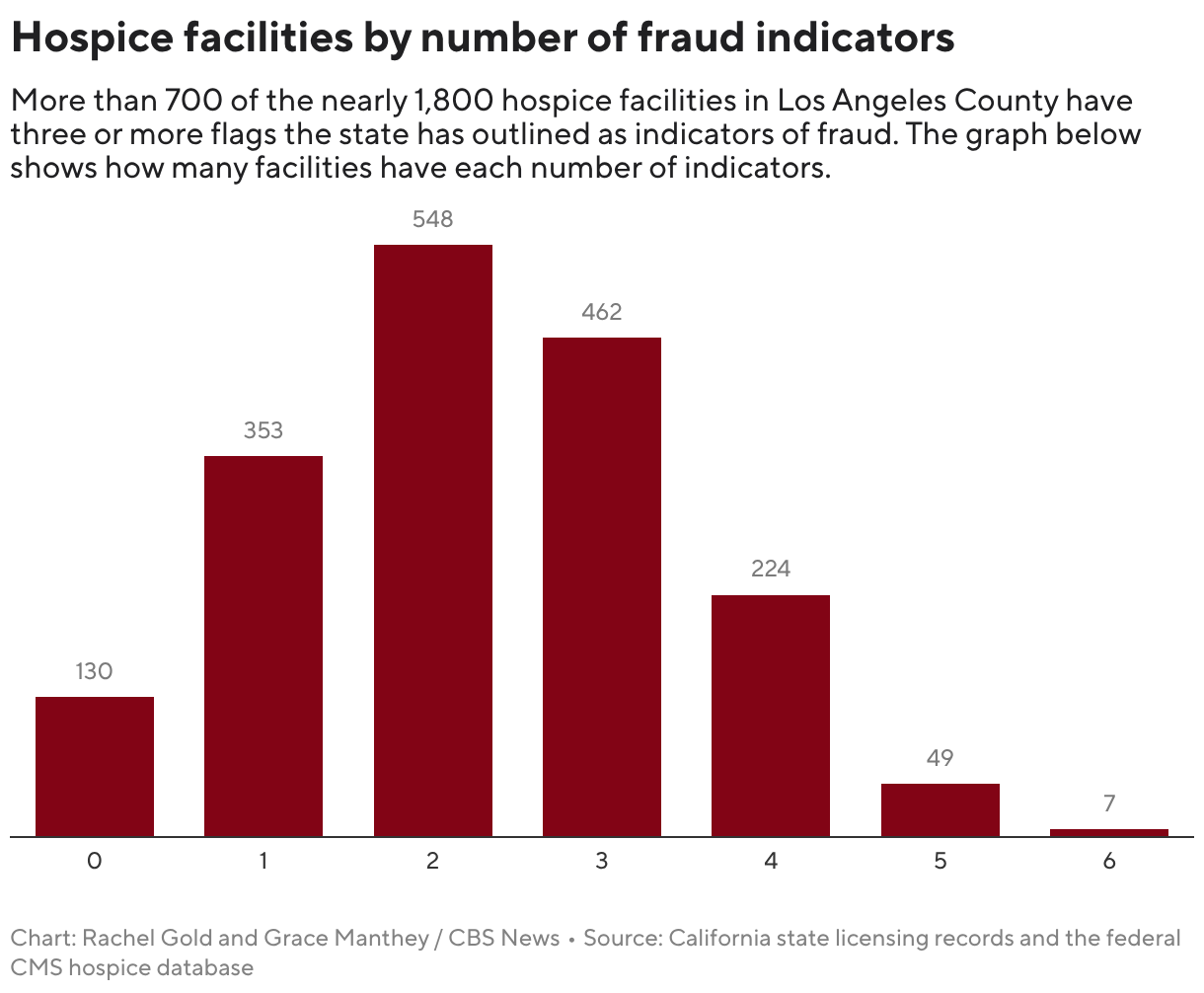
89 licensed hospice companies were registered at a single Los Angeles office building (Merabi Plaza); CBS found 72 of those 89 exhibited at least three regulatory warning signs. A 2022 California State Auditor report noted a 1,500% increase in hospice companies in Los Angeles County since 2010, and federal inspections from 2021–2025 flagged nearly 400 violations across 75 firms. Regulators (California AG, CMS) say enforcement and payment-stoppage efforts have accelerated, implying heightened reimbursement and legal risk for hospice operators that could pressure the sector.
Regulatory escalation in hospice is a structural supply-side shock: aggressive audits and pre-payment scrutiny will disproportionately shrink revenues of small, paper-heavy providers and raise working capital stress. Expect 12–24 months for CMS/state enforcement to translate into measurable claim recoveries and provider closures; conservatively model 10–30% revenue attrition among subscale hospices exposed to clustering and shared-staff models.
Consolidation tailwinds favor operators with enterprise-grade compliance, strong EMR integration, and diversified post-acute footprints — they can absorb higher audit costs and win displaced referrals. That creates a durable margin gap: large, compliant chains should see a 200–500bp relative margin improvement versus fragmented peers as lower-quality entrants exit or are de-risked by payers.
Second-order effects hit commercial stakeholders: vendors selling revenue-cycle, identity-verification, and fraud-detection software should see a 20–40% uptick in procurement cycles; state AG enforcement and CMS payment holds increase Medicare cash-recovery volatility, tightening short-term liquidity across the provider ecosystem. On real estate, localized tenant “papering” disguises vacancy risk in small medical-office portfolios — expect higher capex/leasing costs and selective repricing in submarkets with known clustering within 6–12 months.
AI-powered research, real-time alerts, and portfolio analytics for institutional investors.
Overall Sentiment
strongly negative
Sentiment Score
-0.70
