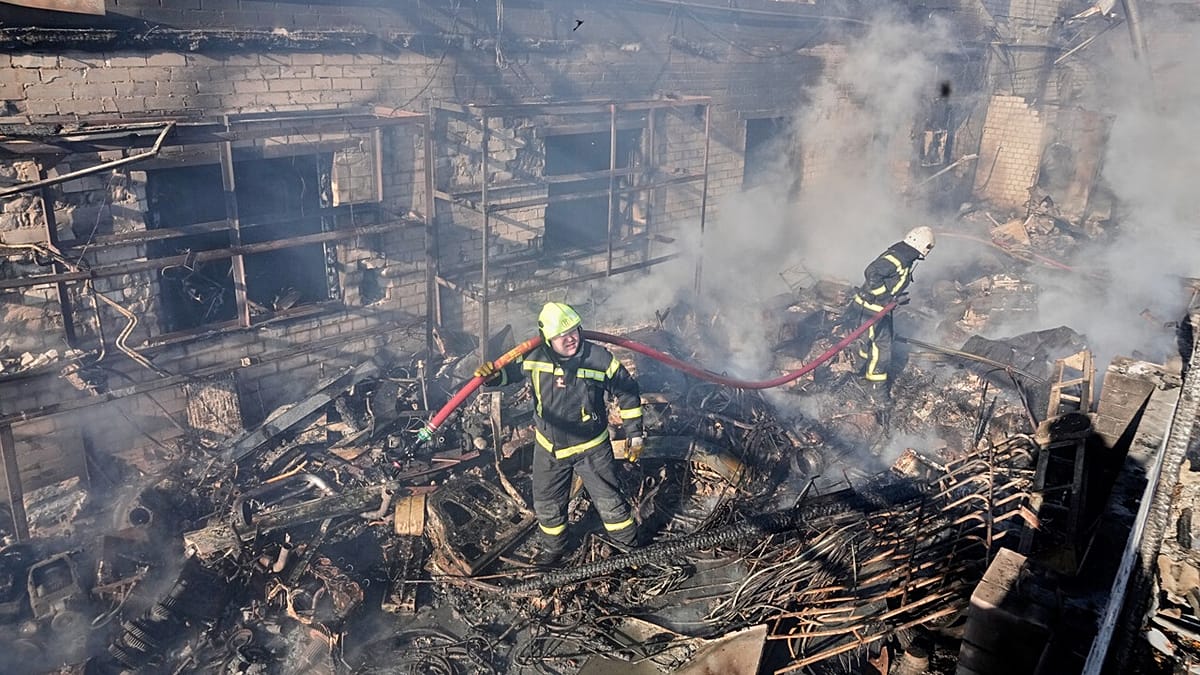
Russia launched what Ukraine says were 430 drones and 68 missiles overnight (Ukraine reports 402 drones and 68 missiles intercepted), hitting four districts of Kyiv region and killing at least 4 people with 15 wounded; regional officials report ~30 damaged sites including residential, educational and critical energy infrastructure. Ukrainian drones also struck facilities in Russia’s Krasnodar region (Port Kavkaz and Afipsky oil refinery), causing injuries and infrastructure damage; Russia says it intercepted 87 Ukrainian drones. Zelenskyy warned U.S. easing of oil sanctions could supply Russia with about $10 billion for the war and called for urgent scaling of air‑defense missile production—implications likely to lift volatility in energy and defense-related markets and stress transport/logistics for commodities.
The immediate market implication is not the strike itself but the step-change in demand for interceptors, guidance electronics, and rapid-production missile subsystems; historically a sustained policy pivot toward replenishment lifts prime defense FCF by ~15-25% within 12–24 months because backlog converts at higher margins than new development work. Production ramp constraints—specialized motor casings, seekers, and RF components—mean unit delivery lead times will likely stay elevated for 6–18 months, keeping prices and margins sticky even absent headline spending increases.
Energy and logistics impacts operate through insurance and rerouting cost channels more than crude fundamentals. Elevated premium floors for Black Sea and nearshore shipping routes raise landed costs for grains and fertilizer, transmitting into volatile commodity spreads over weeks and forcing structural modal shifts (rail/road) that require 3–12 months to absorb capacity — a window where shippers, short-sea carriers, and rail operators can materially reprice. Traders in spot markets will see realized volatility rise, favoring liquidity providers and option sellers on directionally hedged positions.
Key catalyst timelines: (1) short run (days–weeks) = volatility spikes and freight/insurance repricing; (2) medium run (3–12 months) = industrial rerouting capex and defense production ramps; (3) long run (1–3 years) = permanent procurement policy changes and localization of critical suppliers. Reversal risks are clear: an off-ramp via coordinated Western replenishment programs or a credible ceasefire announcement can compress spreads within 4–8 weeks, so directional exposure should be convex and size-managed around those event windows.
AI-powered research, real-time alerts, and portfolio analytics for institutional investors.
Request DemoOverall Sentiment
strongly negative
Sentiment Score
-0.80
