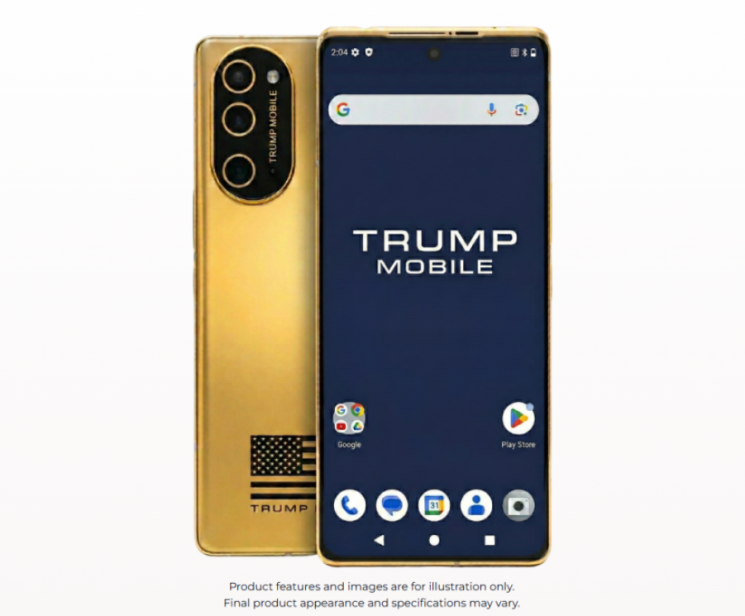
Trump Mobile unveiled a revised gold T1 smartphone design with updated specs, including a 6.78-inch OLED display, 50MP main and front cameras, 512GB storage, a 5,000mAh battery, and Android 15, while keeping the $499 promotional price. However, the release date and final retail pricing remain unfinalized, and the previously stated launch timing has been removed. The site also prominently features Donald Trump Jr. and Eric Trump in new promotional materials, reinforcing the family-business branding.
This is less a handset launch than a branding and distribution test for a politically attached consumer product. The real value driver is not unit volume; it is whether the Trump family can convert attention into a recurring telecom bundle and data monetization layer. That makes the upside asymmetric for adjacent private-label telecom, MVNO enablers, and low-end Android OEMs that can absorb a niche order book, while the major handset supply chain is largely insulated unless the project scales beyond novelty.
The repeated redesign and the removal of a hard launch date are an early warning that the program may be sliding from product launch into perpetual teaser mode. That usually benefits short-cycle marketing, but it hurts credibility with distributors, contract manufacturers, and any financing partner underwriting inventory. If the final device is not meaningfully differentiated on hardware or software, the economic moat collapses to audience capture, which is far easier to copy than to defend.
The more important second-order effect is reputational and regulatory rather than competitive. A politically branded telecom business creates headline risk around service quality, carrier relationships, and consumer-protection scrutiny; any early operational misstep can become a proxy fight in the culture war. That raises the probability of a fast initial sell-through followed by a steep fade in demand once the novelty premium expires, likely within 1-3 quarters post-launch if the device ever ships.
Contrarian view: the market may be overestimating the hardware angle and underestimating the media flywheel. Even if handset margins are thin, the project can still be profitable if it drives low-CAC subscriber acquisition or licensing economics. The setup is therefore not a clean short on the product; it is a watchlist event for whoever supplies the network, OS stack, assembly, or financing, because those counterparties carry the most hidden execution risk.
AI-powered research, real-time alerts, and portfolio analytics for institutional investors.
Request TrialOverall Sentiment
neutral
Sentiment Score
0.10
