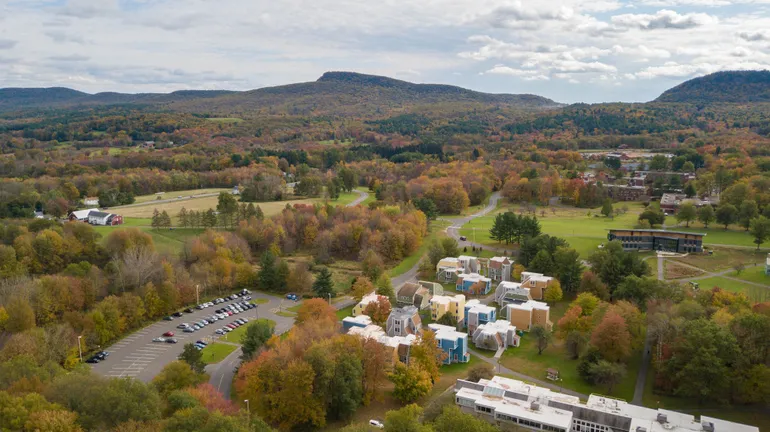
Hampshire College will shut down permanently in December after years of turnaround efforts, citing declining enrollment, long-standing debt, and stalled land development plans. The college will stop enrolling new students, refund deposits, and conduct a teach-out with partner institutions including Amherst, Mount Holyoke, and UMass Amherst. NECHE had warned the school it could face probation or lose accreditation amid $21 billion in bond debt, a September tender deadline, and an 11.3% drop in fall 2025 enrollment to 747 students.
The immediate market read-through is not the closure itself, but the forced crystallization of stranded assets: bondholders, land-development partners, and any lender exposed to tuition-backed cash flows are now effectively in a distressed-workout regime. The key second-order effect is that once a school publicly enters terminal shrinkage, the remaining enrollment curve tends to steepen, because prospective students and faculty treat the institution as optional rather than durable. That makes the shutdown self-reinforcing for other fragile private colleges with similar debt-heavy balance sheets and under-monetized real estate.
The credit lesson is sharper than the headline implies: this looks like a textbook case where illiquid land collateral and delayed refinancing created an illusion of optionality until the operating business could no longer service the capital structure. In practice, the market should expect a widening bid-ask spread for small-cap nonprofit education credits and municipal-adjacent higher-ed financing structures over the next 1-3 quarters, especially where debt service relies on enrollment rebound rather than operating surplus. Any institution with a looming tender date and softening admissions should now trade with a higher probability of covenant stress or forced asset sales.
For the broader education ecosystem, the near-term winners are nearby well-capitalized institutions that can absorb transfer students and possibly acquire faculty, programs, or real estate at distressed valuations. The losers are regional vendors, campus service providers, and local housing/retail landlords that were effectively financed by the school’s continued existence; those revenues usually unwind faster than public commentary anticipates. A subtle contrarian point: the eventual asset sale may still generate headline recoveries, but that does not save the capital structure, because the timing mismatch between asset monetization and debt maturity is what killed the story.
Consensus may underappreciate how contagious a highly visible closure is for the entire sub-segment of small liberal arts colleges. Once one institution shows that teach-out and orderly wind-down are politically acceptable, regulators and boards at similarly stressed schools may move preemptively, accelerating consolidation rather than waiting for a rescue. That argues for treating this as a sector-level early-warning signal, not a one-off idiosyncratic event.
AI-powered research, real-time alerts, and portfolio analytics for institutional investors.
Request TrialOverall Sentiment
strongly negative
Sentiment Score
-0.82
