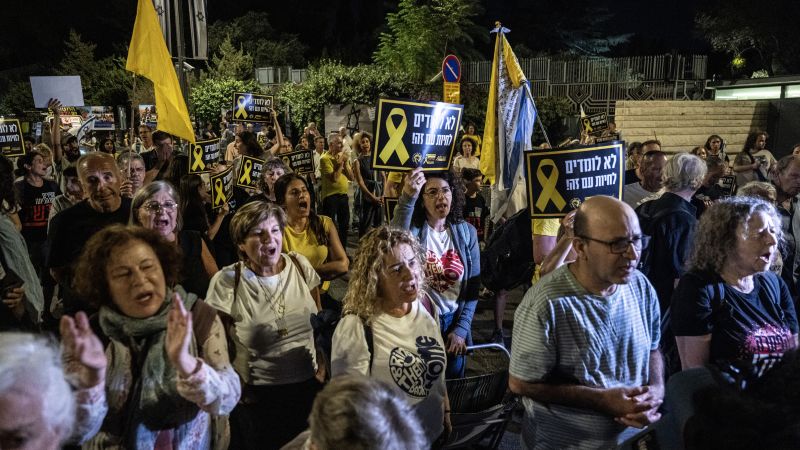
Israel's escalating military operations in Gaza City are intensifying domestic protests demanding a ceasefire and hostage release, driven by heightened fears for the remaining captives. This mounting pressure on the Netanyahu government is compounded by concerns from hostage families and comments from Donald Trump suggesting potential hostage deaths. Despite Hamas accepting a phased deal, Israel has dismissed it, insisting on a comprehensive agreement on maximalist terms, signaling continued military engagement and significant political and humanitarian uncertainty regarding the conflict's trajectory and resolution.
Israel's expansion of its military assault on Gaza City is creating significant domestic political pressure on the Netanyahu government, with large-scale protests demanding a shift in priority from military action to a hostage release deal. The diplomatic channel appears stalled, as Israel has dismissed a Qatari-Egyptian proposal for a 60-day ceasefire, which Hamas had reportedly accepted, in favor of pursuing a comprehensive agreement based on maximalist conditions, including the complete disarmament of Hamas. This widening gap between negotiating positions, coupled with the Israeli Defense Minister's stated intent to continue the offensive, signals a high probability of prolonged conflict and sustained regional instability. The situation is further complicated by mixed signals from the U.S., where President Trump has both endorsed Israel's hardline stance and claimed to be in "very deep negotiations," creating uncertainty about a potential diplomatic off-ramp. The "strongly negative" sentiment and pessimistic tone are underscored by fears for hostage safety, amplified by Trump's comments about potential hostage deaths and acknowledgments from Israeli military officials that the operation poses a risk to captives.
AI-powered research, real-time alerts, and portfolio analytics for institutional investors.
Overall Sentiment
strongly negative
Sentiment Score
-0.70
