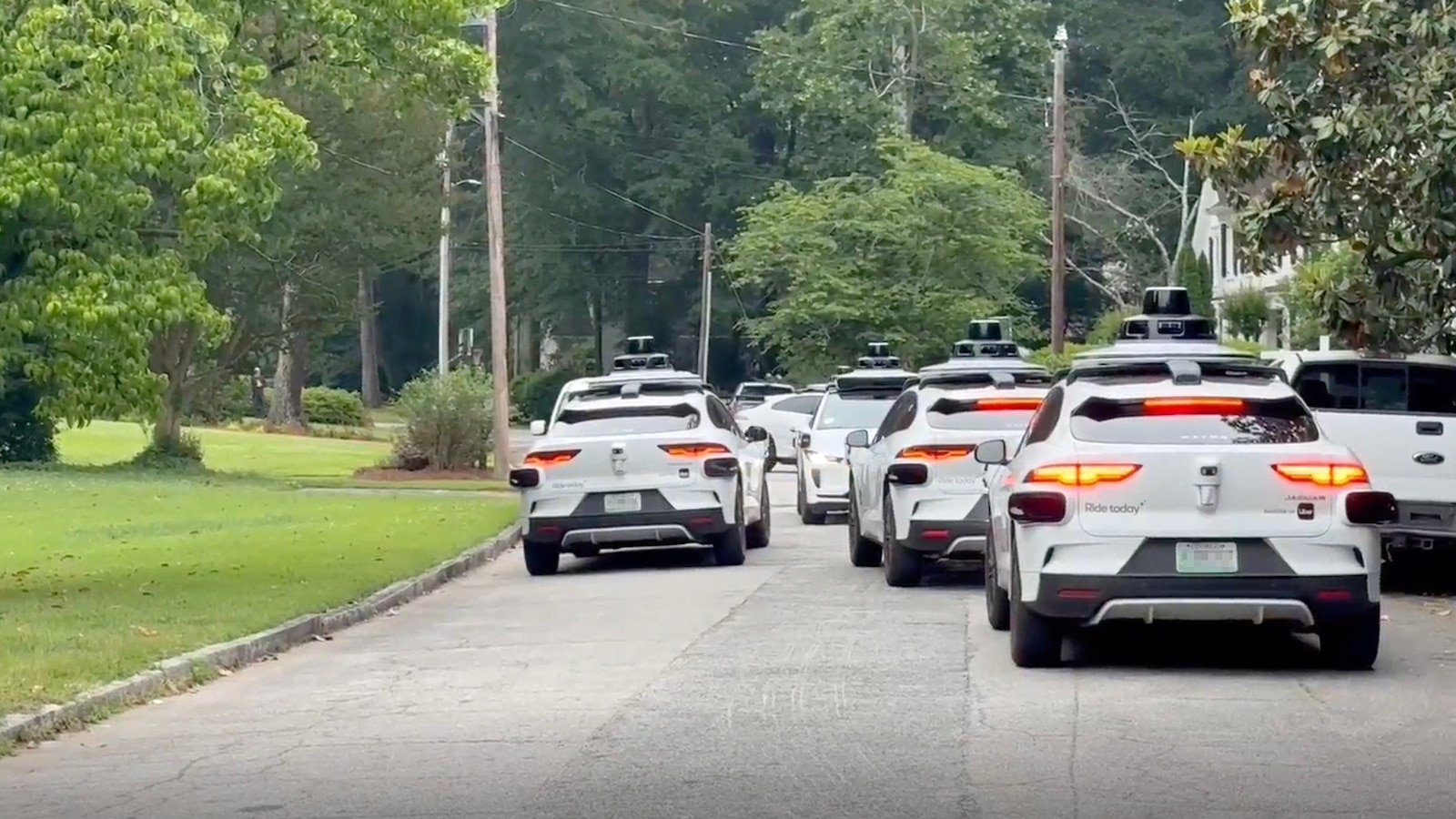
Waymo's driverless vehicles are prompting complaints in a northwest Atlanta neighborhood, with residents saying empty cars have been circling residential cul-de-sacs and creating safety and traffic concerns. Waymo said it has already worked with its fleet partner to address the routing behavior and reiterated that it is committed to being a good neighbor. The article is primarily a local operational issue, with limited near-term market impact.
This is less about a navigation bug than a licensing-and-community friction test for autonomous fleets. The near-term loser is the operator whose unit economics depend on high vehicle utilization; rerouting away from dense residential cut-throughs lowers deadhead efficiency and raises per-trip cost, while any reputational spillover can slow municipal approvals in other expansion markets. The broader beneficiary is the incumbency of human-driven ride-hailing and local logistics operators, because even modest consumer pushback gives cities a reason to demand geofenced restrictions, curfews, or data-sharing requirements that autonomous fleets handle poorly.
The second-order risk is regulatory precedent: a small neighborhood complaint can become a template for broader zoning restrictions if the story is framed as safety, not inconvenience. That matters because AV scaling is path-dependent; a 1-2 quarter delay in route approvals can meaningfully push out payback on fleet depreciation, remote assistance, insurance, and mapping costs. If similar incidents cluster across markets over the next 3-6 months, expect a higher probability of mandatory local operating constraints rather than a federal-level smoothing of rules.
Contrarian view: the market may over-penalize headline risk while underestimating how quickly fleet software can adapt. The fix here is probably a routing-policy tweak, not a product flaw, and that suggests the equity impact should be transient unless there is an actual collision or injury. The more important signal is not this incident itself, but whether management has to sacrifice utilization to preserve community acceptance; if so, the business model’s scaling curve becomes less convex than bulls assume.
For investors, the clean expression is to fade the overhang on autonomy beneficiaries that need local political goodwill, while avoiding overreaction in the broader AI/autonomy basket. In the near term, this should be read as a low-probability but high-frequency headline risk that can recur whenever fleets expand into dense residential grids.
AI-powered research, real-time alerts, and portfolio analytics for institutional investors.
Request DemoOverall Sentiment
mildly negative
Sentiment Score
-0.25
