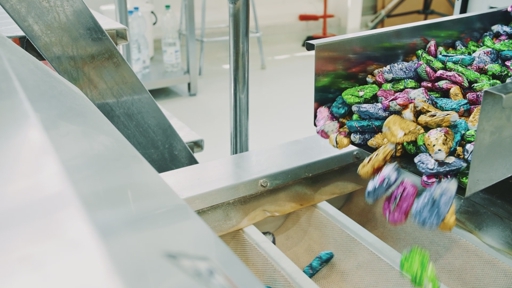
Oxipital AI closed its Series A financing, co-led by SAS Private Equities and Scale Venture Partners, to accelerate deployment of its V-CORTX AI vision platform for food manufacturing. The company cites rapid adoption and is targeting ~400% annual revenue growth in 2026, supported by expansion with global food manufacturers. It also won a production contract to deploy 120 AI vision systems for foreign object detection across multiple lines and facilities, reinforcing traction and scaling momentum.
The investable read-through is less about one private vendor and more about whether AI vision is crossing from demoware into compliance-critical factory infrastructure. If that is real, the first beneficiaries are high-variability, labor-heavy food processors: every point of scrap reduction and fewer line stops flows almost directly into gross margin, and the payback can be faster than a typical ERP/automation project because it also reduces recalls and rework. The second-order winners are industrial integrators and control stacks that can package this into multi-site deployments; the losers are point-solution machine-vision vendors whose economics depend on rigid rule-based systems and hardware attach.
Near term, the market impact is likely muted because this is private-company funding, not a public earnings event. The real catalyst is evidence of repeatability: more than one flagship rollout, expansion from single-line pilots to plant-wide deployments, and proof that installed systems generate measurable labor or yield savings within 12 months. The main failure mode is that integration, data labeling, and uptime challenges stretch payback beyond procurement thresholds, in which case this remains a venture narrative rather than a budget line item.
The contrarian view is that the consensus may be underestimating how non-discretionary food safety and traceability can become after a single foreign-object incident. That said, the 400% growth claim is from a very small base, so the market should not extrapolate venture traction into durable scale without seeing gross margin, churn, and customer concentration. If the company starts winning multi-facility rollouts, expect strategic interest from automation vendors; if not, this will likely stay a niche tool in an already crowded industrial AI stack.
AI-powered research, real-time alerts, and portfolio analytics for institutional investors.
Request DemoOverall Sentiment
moderately positive
Sentiment Score
0.45
