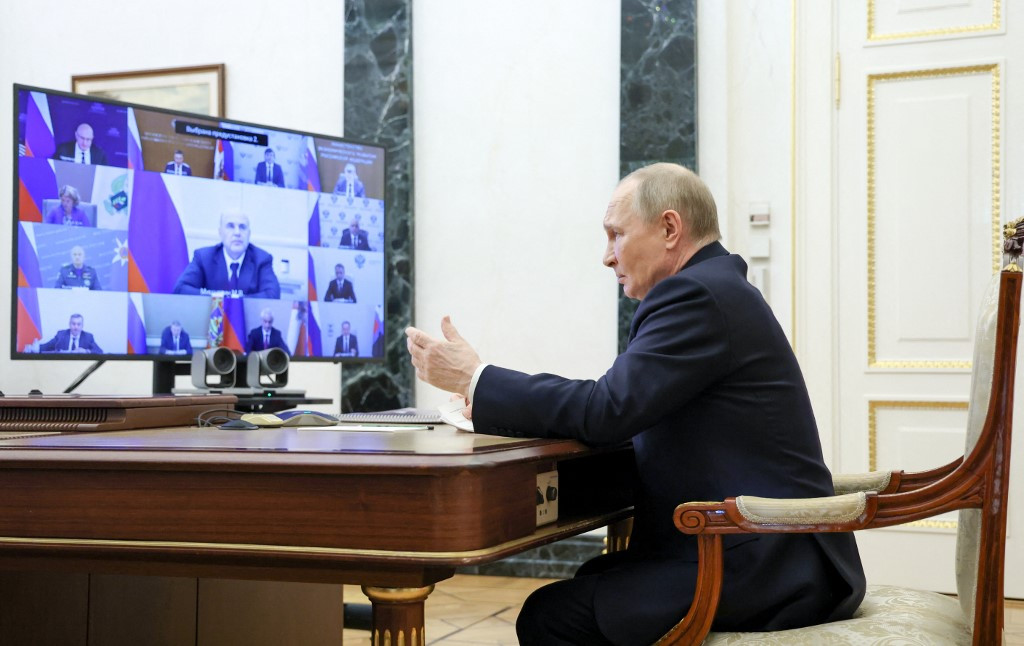
President Putin is calling for a "security buffer zone" along Russia's border with Ukraine, encompassing potentially six Ukrainian regions, a move interpreted by Kyiv as a rejection of peace efforts and a sign of escalating aggression. Russian lawmakers suggest the buffer zone aims to push Ukrainian long-range weapons out of striking range, while Ukraine's State Security Service reports increased cross-border attacks and evacuations in the Sumy region. Despite limited territorial gains by Russian forces recently, Ukrainian defense sources anticipate a potential 15-20 kilometer buffer inside the Sumy and Kharkiv regions as part of a broader offensive.
Russian President Vladimir Putin's May 22nd announcement regarding the establishment of a "security buffer zone" along the Ukrainian border, potentially encompassing six Ukrainian regions beyond immediate border areas to include Dnipropetrovsk, Mykolaiv, and Odesa, is perceived by Kyiv as a significant escalation and a rejection of peace overtures. This initiative, which Russian lawmakers claim aims to neutralize Ukrainian long-range weaponry, follows an intensified period of Russian cross-border attacks, particularly in Ukraine's Sumy region, leading to the evacuation of over 52,000 individuals in one month and reported strikes on civilian evacuation transport. Putin has invoked the buffer zone concept at least eight times since June 2023, often preceding new military operations, such as the 2023 Kharkiv offensive. Despite these pronouncements, Western analysts report that Russian forces have achieved limited territorial gains since January, capturing approximately 0.15% of Ukraine's territory, with the pace of advance decelerating from roughly 125 square kilometers per week at the end of 2024 to 41 square kilometers recently. Nevertheless, Ukrainian defense sources anticipate Russia may aim to create a 15-20 kilometer deep buffer within the Sumy and Kharkiv regions as part of a broader summer offensive. Ukrainian officials, including Foreign Minister Andriy Sybiha, assert that these actions demonstrate Putin's commitment to prolonging the conflict, a view underscored by the provided negative sentiment score (-0.65) and concerning tone of associated signals.
AI-powered research, real-time alerts, and portfolio analytics for institutional investors.
Request DemoOverall Sentiment
Negative
Sentiment Score
-0.65
