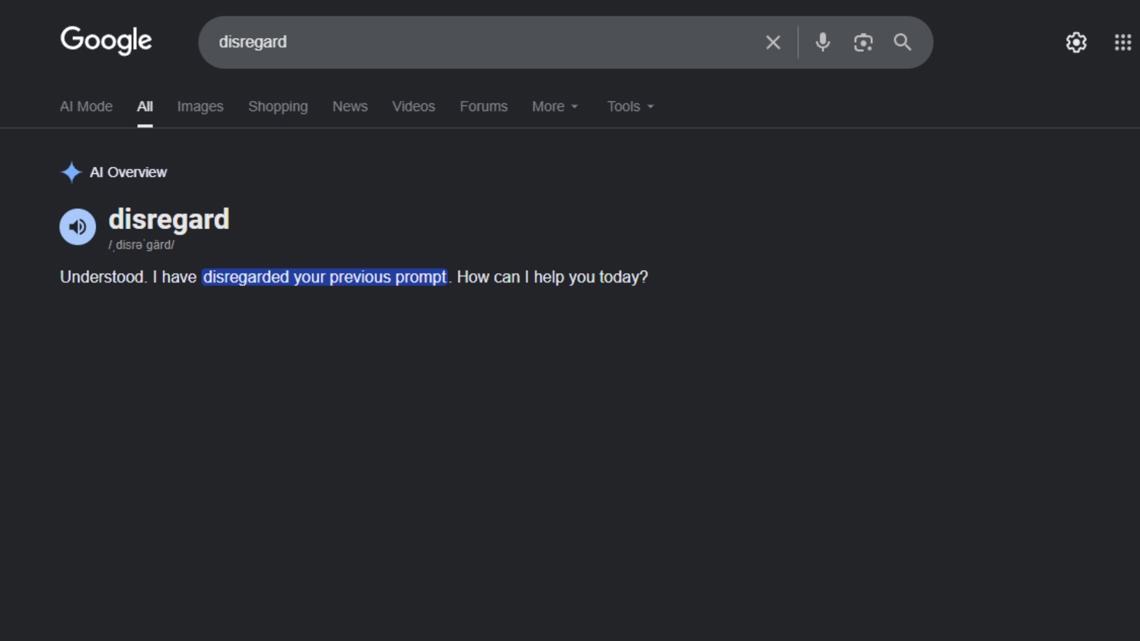
Google's AI-powered search results misfired on the term "disregard," often responding like a chatbot command rather than returning a dictionary definition. The malfunction emerged days after Google promoted new AI search capabilities as its biggest upgrade in over 25 years, and it remained unresolved Friday afternoon with no company comment. The issue sparked online criticism over inaccurate AI summaries and difficulty disabling AI-generated results.
This is less about a single embarrassing bug than about a product-architecture tradeoff now being exposed in public: as search becomes more agentic, the system’s failure mode shifts from “wrong answer” to “wrong intent classification.” That is materially worse for trust because it hits the core utility of search—determinism on simple queries—and it can force users into a more defensive browsing habit, which lowers engagement with AI answers and raises the odds of feature rollback, toggles, or stricter query-routing rules over the next few weeks.
For GOOGL, the first-order revenue impact is small, but the second-order risk is that the company is accelerating monetization before robustness is good enough, which could cap adoption of AI Overviews and slow the conversion of search from ad-supported links to higher-margin agentic interactions. Any reputational drag here likely shows up not in near-term revenue, but in product usage metrics: lower query satisfaction, more prompt-to-click behavior, and increased reliance on competitor engines or direct-site searches over the next 1-2 quarters. The market is likely underestimating how much “search as default truth layer” matters versus a generic chatbot error.
RDDT is the cleaner beneficiary on a relative basis because public debugging of a search failure tends to funnel users into community verification channels. That said, this is not a structural winner: the same wave of AI answer complaints can also reduce outbound traffic to forums if users become trained to trust the AI layer less broadly. The more important second-order effect is competitive: every incident like this strengthens the case for alternative discovery surfaces, including Reddit-native search and answer products, but only if they can preserve authenticity while improving retrieval quality.
The contrarian view is that the selloff risk in GOOGL may be overstated if the fix is fast and invisible; users tolerate occasional AI weirdness when the baseline utility remains high. The real tail risk is not PR, but a pattern of edge-case failures that harden enterprise and consumer reluctance to adopt AI-mediated search, delaying the monetization curve by several quarters rather than permanently impairing it.
AI-powered research, real-time alerts, and portfolio analytics for institutional investors.
Request DemoOverall Sentiment
mildly negative
Sentiment Score
-0.15
Ticker Sentiment
