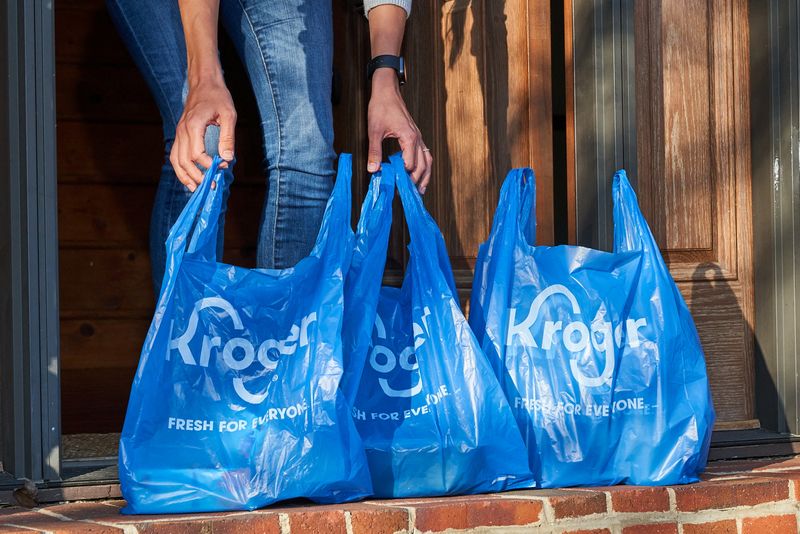
UBS cut Kroger’s price target to $63 from $70 while keeping a Neutral rating, citing the need for time to prove its investment-led turnaround. Kroger’s Q1 fiscal 2026 results were mixed: adjusted EPS came in at $1.58, in line with estimates, while revenue of $46.1 billion beat the $45.35 billion consensus. However, investors remain focused on margin pressure and a cautious outlook, even as UBS said the stock may be undervalued and could ultimately support a low-to-mid teens P/E if long-term targets are achieved.
This reads less like a clean idiosyncratic company story and more like a marginally negative signal for the entire “execution recovery” basket in grocery. When a large operator is forced to keep leaning on future savings to fund pricing and service investments, the market should assume the payback period is longer than management teams typically communicate; that usually compresses valuation before it fixes operating issues. For Kroger, the immediate risk is not outright demand loss but an extended margin-repair process where every quarter of execution risk keeps the multiple pinned.
The second-order effect is on competitors: regional grocers and club operators with cleaner balance sheets can continue defending share with targeted price actions while Kroger spends into the gap. That creates a near-term winner set among faster-acting format leaders, but it also raises the odds of a broader promotional response if Kroger’s pricing discipline slips. In that scenario, the whole food-at-home complex can see a temporary gross-margin reset before volume benefits show up.
The breach angle is more interesting than the usual single-company headline because it introduces an asymmetric risk that can extend beyond the named parties. If the exposure meaningfully touched supplier, logistics, or engineering data, the real impact would be delayed: harder contract renegotiations, tighter vendor controls, and potentially slower cross-border sourcing decisions over the next 1-3 quarters. That is a classic underappreciated overhang for industrial and consumer-tech supply chains, even if the market initially treats it as noise.
Consensus may be underestimating how little near-term proof is needed for the stock to rerate lower again: if operating income growth misses the low end of the target range for just another two reporting cycles, the market will likely stop paying for the long-duration turnaround narrative. Conversely, the setup is not one-way bearish; if management can show even modest same-store resilience while funding investment internally, the stock can bounce hard from depressed levels because expectations are already low. The key is that the burden of proof is now on sequential margin stabilization, not headline revenue growth.
AI-powered research, real-time alerts, and portfolio analytics for institutional investors.
Request DemoOverall Sentiment
mixed
Sentiment Score
-0.10
Ticker Sentiment
