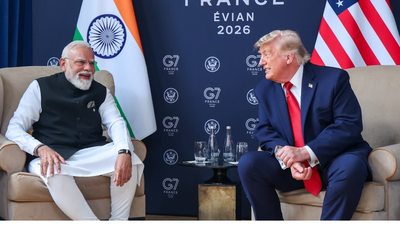
G7 leaders are focused on two major geopolitical flashpoints: the Russia-Ukraine war and the preliminary US-Iran deal, with discussions centered on tougher sanctions on Russian oil and gas, continued support for Ukraine, and next steps on Iran’s nuclear and missile programmes. The summit also highlights Strait of Hormuz security and global energy supply risks, with France and Britain exploring maritime security options. PM Modi’s meetings with Macron and Trump, alongside Zelenskyy’s push for renewed backing, add to the high-stakes diplomatic backdrop.
The market read-through is less about headlines and more about sequencing: the summit is trying to compress two separate risk premia — Eurasian war risk and Gulf energy-shock risk — into a single diplomatic reset. That usually benefits cyclicals with high geopolitical beta only if the talks produce enforceable follow-through; absent that, the first move is often a relief rally in energy-sensitive assets, followed by a fade once traders realize enforcement and burden-sharing are unresolved. The key second-order effect is that Europe is effectively asking for a security umbrella without conceding strategic autonomy, which increases the odds of policy friction rather than immediate policy clarity.
For equities, the biggest near-term winners are not oil producers but downstream users of lower volatility: airlines, chemicals, industrials, and EM importers that are most sensitive to a rising oil risk premium and freight insurance costs. Conversely, defense names with already elevated expectations may underperform if the market interprets the summit as reducing tail risk without reducing base-case military spend; the better trade is on suppliers tied to replenishment and air defense munitions rather than prime contractors. In fixed income, any credible de-escalation should compress term premia in Europe faster than in the US, especially if it lowers the odds of emergency energy-stockpiling this winter.
The contrarian view is that the consensus is overstating the durability of any diplomatic breakthrough. A preliminary framework that leaves enforcement, verification, and regional security unspecified tends to reduce volatility for days, not quarters, and can even increase it later if compliance questions surface. The more interesting trade is to position for lower implied vol now, then own convexity into the next renegotiation or ceasefire failure window, which is likely within 1-3 months rather than immediately.
The Ukraine angle also argues for a barbell: short-duration European beneficiaries of lower gas/oil volatility on one side, and long-duration defense/air-defense exposure on the other. If the summit produces harsher sanctions language without concrete implementation, Russian energy flows may reroute again rather than shrink, limiting the upside to oil prices but still keeping sanctions-sensitive shipping, insurers, and commodity traders on edge.
AI-powered research, real-time alerts, and portfolio analytics for institutional investors.
Request DemoOverall Sentiment
neutral
Sentiment Score
0.05
