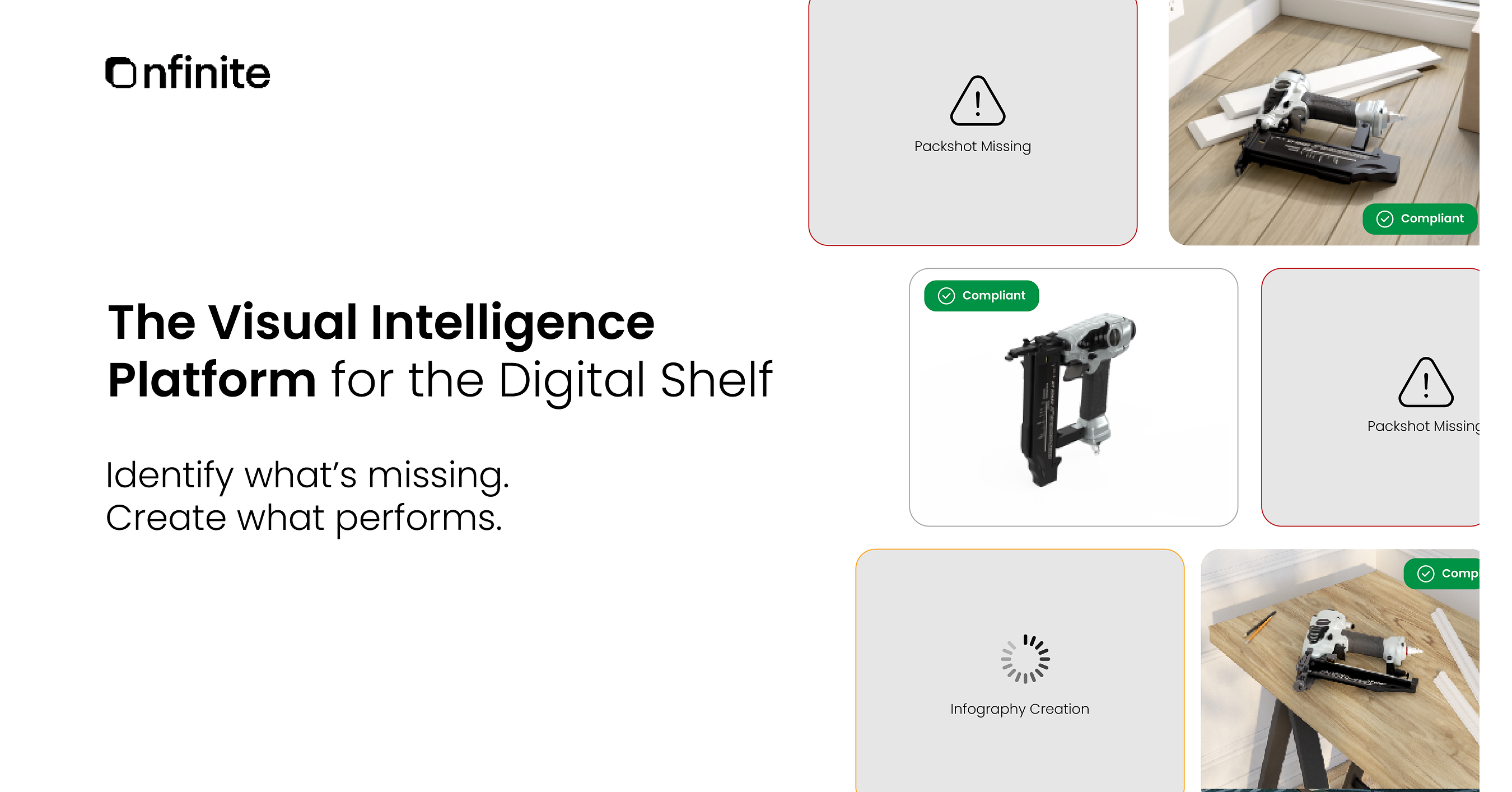
Nfinite launched its Visual Intelligence Platform for the Digital Shelf to monitor product-image compliance and generate publish-ready visuals at scale. The company claims non-compliant pages can cost 15–25% of revenue and that manual compliance checks consume ~40 hours per SKU annually, while an early scan found 897 content gaps and a 61% compliance score for one DIY brand across seven retailer endpoints. Overall, this is a new product/technology release positioned to improve conversion and reduce rework, but the article provides no direct financial impact or guidance.
This is more of a workflow automation story than a clean revenue catalyst for public equities. The economic lever is not image generation itself, but whether tighter visual compliance improves conversion enough to justify budget reallocation from manual content ops to software and AI services. In the near term, the biggest beneficiaries are large-SKU merchants that can spread fixed compliance tooling across volume; the risk is that this quickly gets absorbed into existing PIM/DAM/commerce stacks and becomes a feature, not a standalone spend category.
The second-order losers are the labor-heavy product-content and studio workflows that still depend on manual checks, revisions, and vendor coordination. That pressure should show up first in outsourced agencies and low-value content service providers, then later in slower hiring for e-commerce ops teams. For listed names, the most plausible long beneficiaries are commerce platforms and retailers with complex assortments and private-label exposure, but the earnings impact is likely incremental rather than enough to move multiples on its own.
The contrarian point is that the market may overpay for the AI-generation angle and underpay for the data moat. If Nfinite truly owns a retailer-requirements database and can prioritize the highest-conviction fixes, that is more defensible than generic creative automation; if not, adoption will be slowed by governance, legal review, and retailer-specific onboarding. Watch the 1-3 month window for proof of enterprise logos, measurable conversion lift, and whether retailers actually embed compliance scoring into merchandising workflows; without that, this remains a niche feature with limited public-market read-through.
AI-powered research, real-time alerts, and portfolio analytics for institutional investors.
Request DemoOverall Sentiment
mildly positive
Sentiment Score
0.25
Ticker Sentiment
