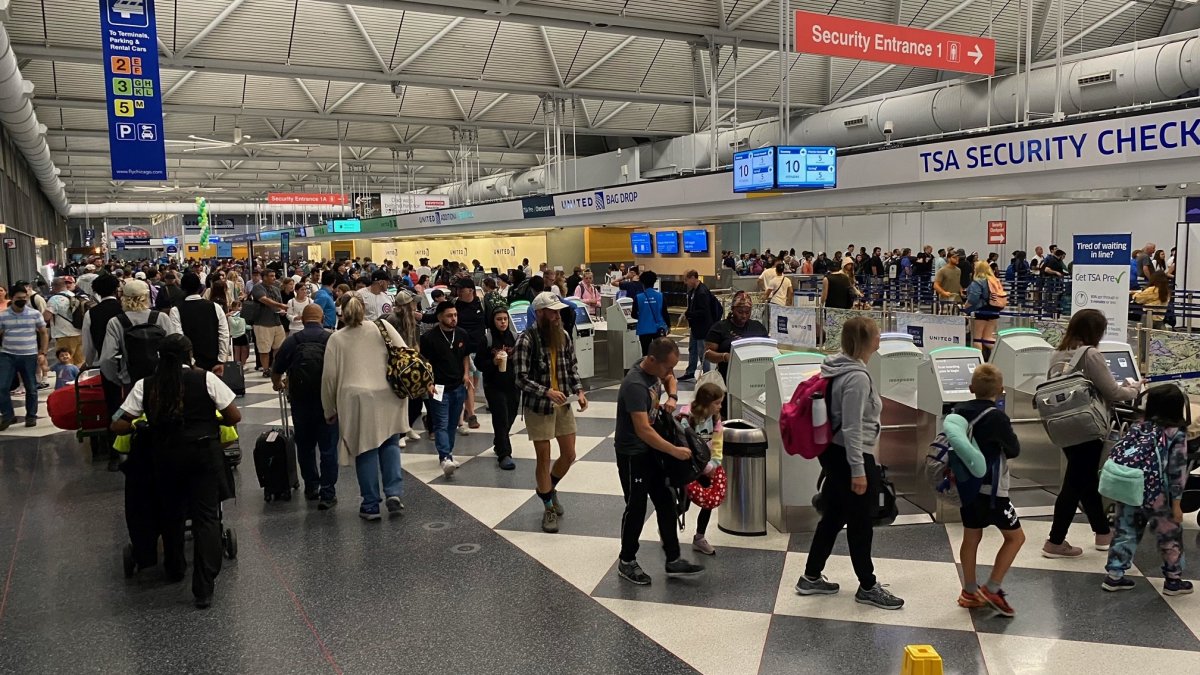
3.7 million passengers are expected to pass through O'Hare and Midway over the next 12 days, with O'Hare's single busiest day projected at ~296,000 passengers. A 33-day partial DHS shutdown has left roughly 50,000 TSA agents working without pay, increasing callouts and producing reported security wait times of 2–3+ hours in some locations and prompting possible checkpoint consolidations. Near-term operational risk and passenger disruption for airlines and airport services is elevated, though systemic market risk is limited because FAA air traffic controllers remain funded, reducing the likelihood of widespread cancellations. Monitor TSA staffing trends and local wait-time data for short-term impacts to regional carriers and airport-dependent retail revenue.
Operationally, this is a capacity shock with high kurtosis: small increases in TSA callouts or checkpoint consolidations create non-linear queuing blow-ups because throughput falls faster than agent headcount. That amplifies missed-connections and rebooking flows disproportionately on peak travel days, forcing airlines into outsized IRROPS costs, ad-hoc staffing, and customer-pleasing concessions that compress margins on high-utilization leisure routes.
Second-order winners are the non-airline travel touchpoints where dwell-time rises — rideshare, curbside/valet, short-term parking, and food & retail inside terminals see higher per-passenger revenue even if flight yield is unchanged. Conversely, network-sensitive carriers (high-frequency feeders, tight-connection hubs) face outsized operational risk; regional partners with single-bank schedules are most fragile because one checkpoint consolidation cascades across their day.
The political/cashflow catalyst set is binary and fast: a DHS funding resolution can normalize staffing within days, but attrition and training mean residual capacity shortfalls can persist for months. Tail risk is an episodic localized airport closure or multi-day checkpoint consolidation that spikes realized volatility in travel names and forces meaningful short-term revenue rerouting.
For markets, expect elevated implied volatility in airline and travel ETFs into near-term funding votes and peak travel windows, then rapid mean reversion if the shutdown ends. That creates clean, time-boxed option plays and pair trades that exploit the asymmetric impact on airport-adjacent services versus carrier P&Ls.
AI-powered research, real-time alerts, and portfolio analytics for institutional investors.
Request DemoOverall Sentiment
mildly negative
Sentiment Score
-0.35
