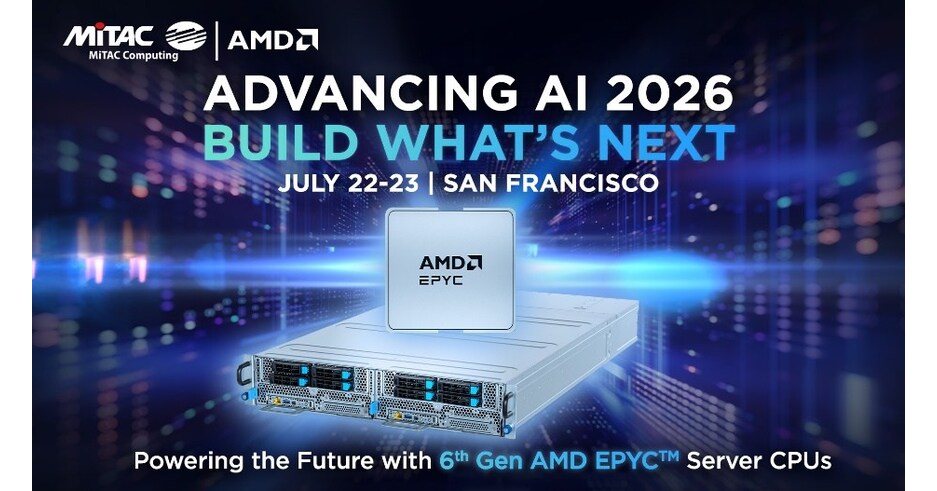
MiTAC Computing launched an agentic AI infrastructure based on AMD EPYC Server 6th Gen CPUs, including the 2U dual-node M2810Z6 (up to 16 DIMMs, up to 4TB DDR5-8000, cTDP up to 600W per node) and the more cost-focused M2610Z6 (up to 4TB DDR5-6000, cTDP up to 400W). For higher-demand workloads, it also unveiled the 2U dual-socket eTN85-B8261 supporting AMD Instinct MI350P GPUs plus the Pollara 400 AI NIC, and a rack-scale solution claiming 50% higher GPU density per rack and up to 33% less data-center space. Overall, the news is positive for MiTAC/AMD’s AI server platform roadmap, but it is product-focused with limited immediate financial read-through.
This reads as ecosystem validation, not a near-term earnings event. For AMD, the important mechanism is that server OEMs are now building full-stack racks around its CPUs plus accelerators, which improves platform stickiness and raises the switching cost for data-center buyers. That matters more for valuation than quarterly revenue: if AMD can keep winning socket share in dense systems, the market can start underwriting a larger share of the AI infrastructure bill even before GPU volumes become material.
The second-order effect is on competition, not just on AMD. Intel loses another visible design-win signal in the enterprise/virtualization layer, where CPU share often moves first and GPU share follows later. MiTAC likely captures modest integration value, but over time rack-level solutions tend to commoditize hardware gross margins unless the vendor owns cooling, power, and deployment services; that shifts profit pool toward whoever controls the system architecture and support contracts.
Near term, the stock reaction should be muted unless this converts into actual bookings or a meaningful upgrade to AMD’s data-center guide. The key catalyst is 1-3 months out: hyperscaler capex commentary, MI350 shipment cadence, and whether AMD can show that EPYC is pulling through AI rack demand rather than just riding promotional slides. Falsifiers are simple: weak data-center revenue growth, no improvement in server CPU share, or gross margin pressure from mix and pricing. The consensus may be missing that AMD’s upside is increasingly a platform story, not a single-product GPU story.
AI-powered research, real-time alerts, and portfolio analytics for institutional investors.
Request DemoOverall Sentiment
mildly positive
Sentiment Score
0.28
Ticker Sentiment
