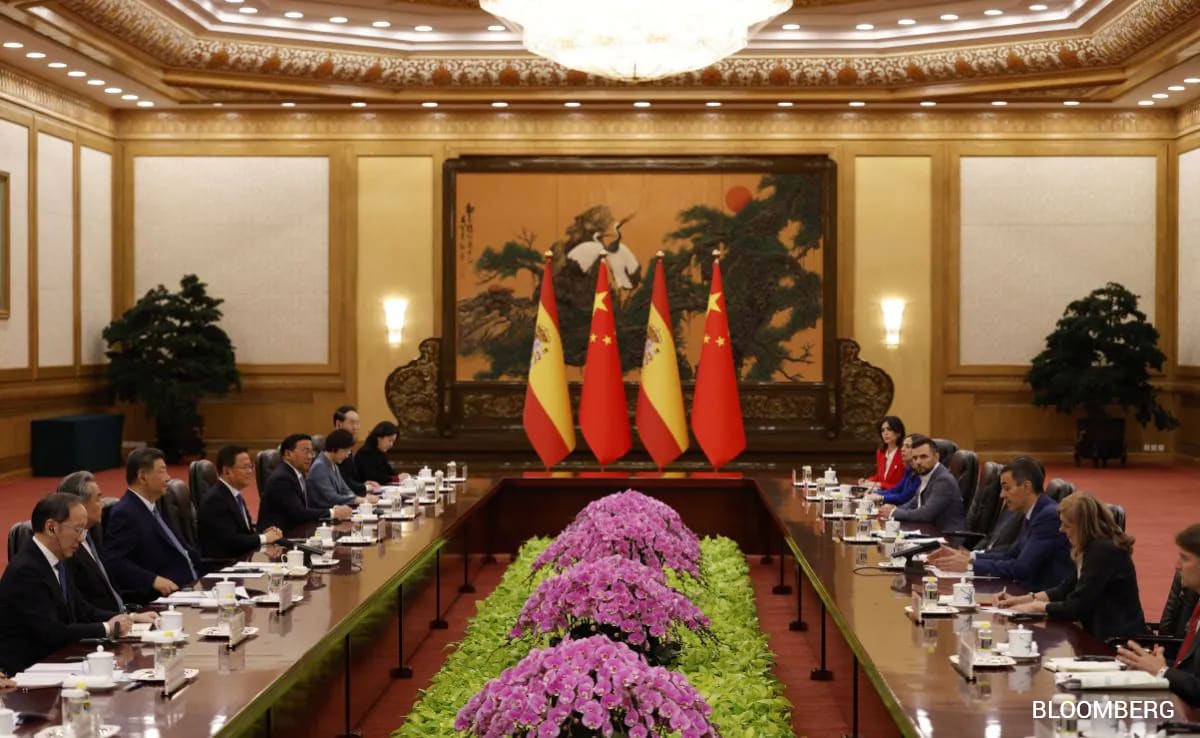
Xi Jinping and Pedro Sanchez used their Beijing meeting to emphasize China-Spain alignment on resisting global disorder, with both sides criticizing US-Israeli strikes on Iran and calling for de-escalation. Sanchez pressed China to use its influence on conflicts in Iran and Ukraine, while Spain positioned itself as one of Beijing’s closest EU partners. The article is primarily geopolitical and unlikely to move markets directly, though it reinforces risk-sensitive narratives around the Middle East and Europe-China relations.
This is less about rhetoric and more about a widening political lane for selective European de-risking from the U.S. consensus. Spain is signaling that parts of Europe are willing to trade strategic ambiguity for commercial optionality with China, which matters most for sectors where policy permissions, not demand, are the binding constraint: autos, industrial machinery, grid equipment, and dual-use supply chains.
The second-order effect is that China can use “middle-power” relationships to fragment Europe’s bargaining position on tariffs, export controls, and sanctions architecture. If Madrid keeps leaning into this posture, expect Beijing to reward Spanish firms and infrastructure projects first, while testing whether other southern European governments are willing to dilute Brussels’ unified stance in exchange for investment and market access. That creates a medium-term winner/loser split inside Europe: globally exposed multinationals with China revenue may gain incremental access, while firms dependent on a hard EU line on China policy face slower relief and higher compliance risk.
For markets, the near-term tradeable read is not directional risk-on/risk-off but dispersion. The cleanest expression is long Spain versus broader Europe if investors begin to price a modest China-facing investment premium into Iberia, while shorting names that are most exposed to renewed transatlantic policy friction or supply-chain re-routing costs. In FX, any incremental EU fragmentation narrative is mildly negative for EUR on the margin, but the larger effect is cross-asset volatility in rates-sensitive European cyclicals rather than outright currency weakness.
The contrarian view is that this may be mostly signaling with limited policy transferability: Spain has few unilateral tools that can materially alter U.S.-China or EU-China trade flows, and Beijing has a long history of overestimating bilateral warmth with individual European capitals. If the U.S. or Brussels hardens tariff or export-control policy, Spain’s room to maneuver shrinks quickly, and the market could reverse on disappointment within 1-3 months.
AI-powered research, real-time alerts, and portfolio analytics for institutional investors.
Request TrialOverall Sentiment
neutral
Sentiment Score
-0.05
