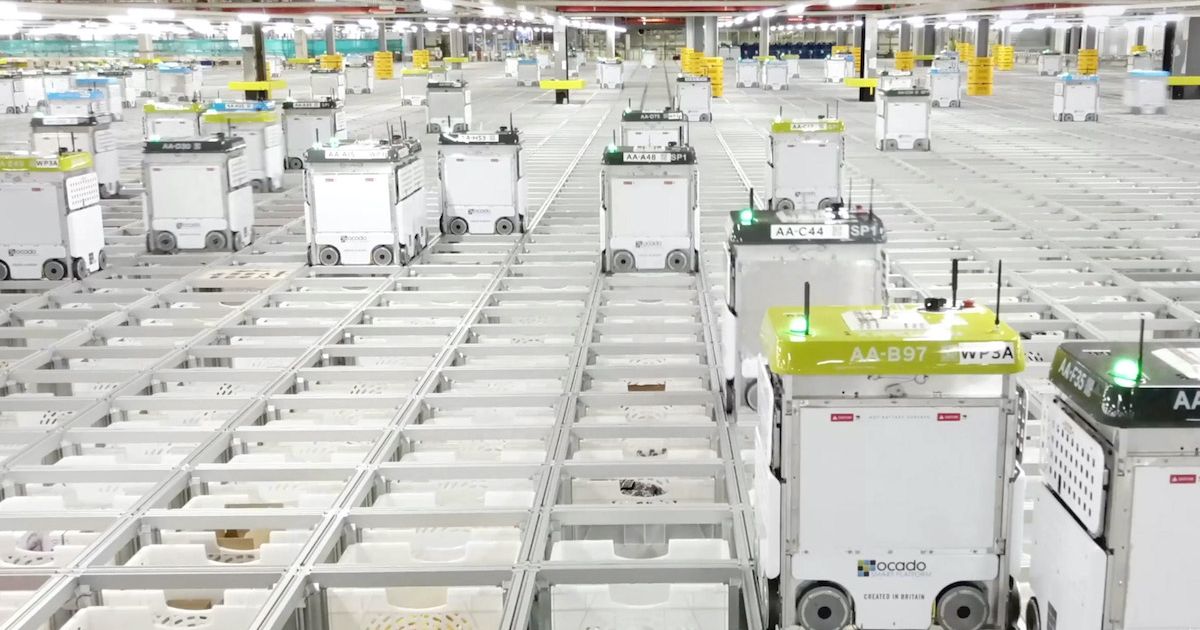
Ocado reported adjusted EBITDA up 59% to £178m on group revenue growth of 12.1% to £1.4bn for the 52 weeks to 30 Nov 2025, with Technology Solutions EBITDA up 73% to £140m, Ocado Logistics EBITDA £38m and Ocado Retail (50% JV) EBITDA £84m. Statutory profit swung to a £395m profit from a £374m loss primarily due to a revaluation gain after Ocado Retail's deconsolidation, while underlying cash flow remained negative £213m (vs £199m prior). Management said the group is on track to turn cash flow positive in H2 2026 and deliver full-year cash generation in 2027, but flagged a “significant” round of job cuts and noted recent retrenchment by overseas partners (Sobeys, Kroger), highlighting execution and demand risks despite improving profitability.
Market structure: Ocado’s cost cuts and a 73% jump in Technology Solutions EBITDA suggest the company can win on margin expansion even as some international partners retrench; direct beneficiaries are Ocado technology (OCDO.L) and Ocado Retail JV participants (Marks & Spencer, MKS.L) via higher JV profitability, while automation-dependent partners (e.g., Kroger, KR) and builders/operators of on-premises robot CFCs face stranded-capex risk. Competitive dynamics tighten for legacy fulfilment contractors but loosen for Ocado if it can translate international volume growth (reported +26%) into new licensing deals; however visible partner pullbacks reduce Ocado’s referenceability and could blunt pricing power in FY26. Cross-asset: improving cash flow prospects should compress OCDO credit spreads (better bond bid) and reduce equity implied volatility; GBP-sensitive revenues and USD/CAD exposures from North American contracts create FX tail risk for earnings in H2 2026. Commodities impact is minimal.
Risk assessment: Tail risks include accelerated partner contract cancellations (Sobeys/Kroger precedent) triggering lump-sum impairment or penalty claims, a significant warehouse operational failure, or a technology obsolescence cycle that forces replatforming—each could reverse forecasted FCF and cause >30% equity drawdowns. Timeline: immediate (days) — share price reaction to job-cut messaging; short-term (3–6 months) — partner decisions and order flow; long-term (H2 2026–2027) — cash-flow inflection and full-year generation target. Hidden dependency: the FY25 statutory profit benefited from a revaluation on deconsolidation of Ocado Retail; underlying cash flow still negative £213m, so operational generation must materialize to justify valuations. Catalysts to watch: new international contract signings, quarterly volume growth cadence, and any disclosure of headcount reduction magnitude within 30–90 days.
Trade implications: For investors willing to take event risk, a targeted 2–3% long position in Ocado (OCDO.L) is warranted ahead of the H2 2026 FCF inflection, with a 25% stop-loss and a 40–60% upside target into end-2027 if cash flow guidance is met; pair this with buying a 12–18 month protective put (10–15% OTM) sized to 25% of the equity position to cap tail risk. Relative-value: short a 1–2% position in Kroger (KR) as automation pullback indicates slower multi-year CapEx growth; set a 15% downside target over 6–12 months and stop-loss if KR posts two consecutive quarters of margin expansion. Options: consider a cheap call spread on OCDO expiring Jan 2028 (buy ATM, sell +30% OTM) funded by selling a small amount of near-term volatility if IV spikes post-announcement. Rotate modest exposure from broad retail (XRT) into logistics/automation winners and defensive grocery retailers benefiting from cost-savings.
Contrarian angles: The market may be over-indexing on partner exits and under-weighting the internal margin leverage—Technology Solutions’ EBITDA growth (to £140m) shows unit economics can improve without new large CFC roll-outs; if Ocado delivers H2 2026 positive FCF, a re-rating is plausible. Conversely, consensus may under-appreciate execution risk from undisclosed headcount cuts—losing key engineers accelerates product risk and could delay deployments by 6–12 months. Historical parallels: previous automation vendors recovered after early partner churn by shifting to software-as-a-service licensing; if Ocado pivots similarly, downside is limited but governance and contract transparency will be key to re-pricing.
AI-powered research, real-time alerts, and portfolio analytics for institutional investors.
Request TrialOverall Sentiment
mildly positive
Sentiment Score
0.25
Ticker Sentiment
